Affordable Bathroom Remodel: Costs, Cuts and Priorities
Plan an affordable bathroom remodel with real cost ranges, smart scope cuts, DIY vs pro tasks and payback tips so you spend where it matters most.
By Excellent Home Improvement & Remodeling
$45,000 is where the top 10% of US bathroom remodel projects begin, according to the 2024 U.S. Houzz & Home Study. Almost no homeowner needs to reach that tier. What separates a sensible project from a premium one is scope, decided long before anyone swings a hammer: how much plumbing moves, how much water control gets rebuilt, and whether the shower comes out.
Affordability in a bathroom is a design decision first and a shopping decision second. Price the scope, order the work so tight money doesn't buy rework, and run a payback test on every efficiency upgrade before you commit to it. That sequence is what keeps an affordable bathroom remodel affordable through the last invoice instead of only on the first deposit.
Table of Contents
- What an Affordable Bathroom Remodel Really Costs
- How to Sequence the Work When Money Is Tight
- Cut Scope and Material Costs Without Cheap Mistakes
- DIY or Hire a Pro for Each Bathroom Task
- Pay Back Efficiency Upgrades Before You Buy
- Confirm a Written Scope Before You Commit
What an Affordable Bathroom Remodel Really Costs
The national spread starts wide and stays wide. The 2024 U.S. Houzz Bathroom Trends Study, which surveyed 1,247 homeowners, put the median cost of all bathroom remodels at $15,000 in 2023, an 11% rise from $13,500 in 2022. A single average isn't a plan. Split the same data by scope and room size and it turns into a budget you can defend in a contractor's office.
Two scope levels decide the price before materials do
The study draws its line at the shower. A minor remodel leaves the shower area unchanged and had a median cost of $8,500 in 2023, up from $8,000. A major remodel, where the shower is upgraded, reached a $21,000 median against $20,000 the year before. That enclosure is the fault line in every budget I write. Once a shower or tub comes out, demolition, substrate, waterproofing, pan, drain, tile and glass arrive as a package, and none of it is optional.
Room size moves the number again. Minor work in bathrooms under 100 square feet came in at $6,000, a 20% climb from $5,000, while the same scope in rooms of 100 square feet or more hit $11,500, up 15%. Small rooms cost less because they hold less: fewer square feet of tile, fewer fixtures, less cutting, less waste.
The trend has run one direction since. Major remodels of small primary bathrooms under 100 square feet reached a $17,000 median in 2024, a 13% increase, per Houzz's 2025 renovation spending trends, while the national major-remodel median rose to $22,000 in 2024 from $21,000, according to the 2025 U.S. Houzz Bathroom Trends Study.
Find your row, then add contingency
Median US homeowner spend by project scope and bathroom size, from Houzz data:
| Scope level | What changes | Median cost |
|---|---|---|
| All bathroom remodels, national median | Mixed scopes | $15,000 (2023) |
| Minor remodel, shower left unchanged | Vanity, fixtures, floor tile, paint, lighting | $8,500 (2023) |
| Minor remodel, bathroom under 100 sq ft | Same scope in a small room | $6,000 (2023) |
| Minor remodel, bathroom 100 sq ft or more | Same scope in a larger room | $11,500 (2023) |
| Major remodel with shower upgrade | New shower or tub, waterproofing, tile, vanity | $21,000 (2023) |
| Major remodel, small primary bath under 100 sq ft | Full shower upgrade in a small room | $17,000 (2024) |
| Major remodel, national median | Full remodel with shower work | $22,000 (2024) |
Read the table as reported homeowner spending, not as a contractor's quotation. The figures already include whatever those homeowners chose to buy and whatever their local market charged for labor. New York City sits at the expensive end of both, and building requirements in co-ops and older housing add scope a national median can't see.
Practical rule: match your scope level and room size to one row, add a 15 percent contingency for what demolition uncovers, and treat that total as your ceiling rather than your target.
When you compare those rows with what a bathroom renovation costs in New York, most of the gap is labor, permits and building requirements, not tile. A homeowner holding a $8,500 budget and a $21,000 plan isn't in trouble. They're in the wrong row.
How to Sequence the Work When Money Is Tight
Tight money is a cash-flow problem before it's a materials problem. The order below isn't a preference. It follows the physics of the room: water control and plumbing have to be settled while the walls are open, and finishes can wait for any year you can afford them.
The sequence below turns one large bill into a defensible plan, and it stops a cheap phase from creating an expensive one later.
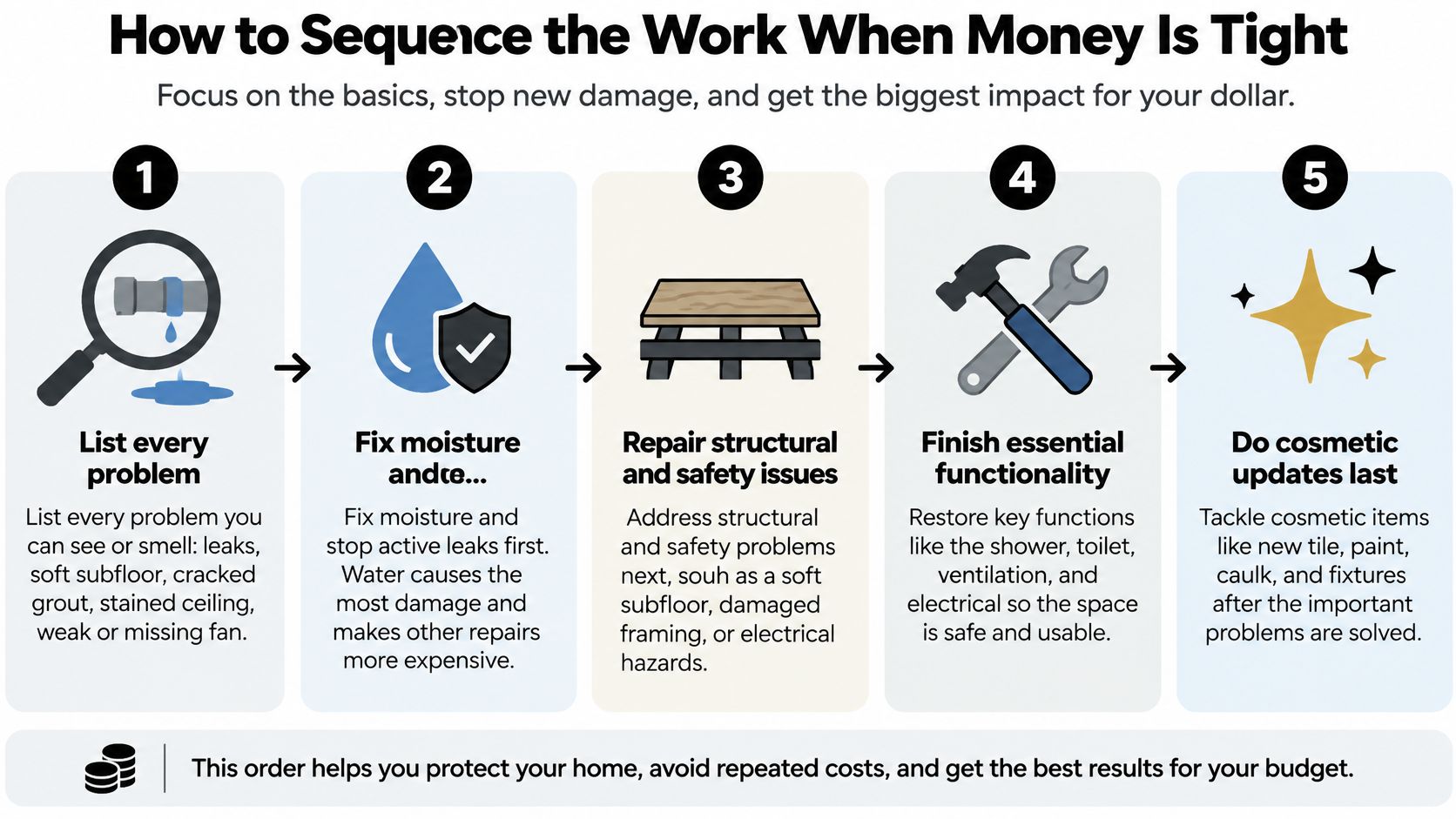
- List every problem you can see or smell. Walk the room with a flashlight: a stained ceiling under the upstairs bath, a soft subfloor at the toilet flange, cracked grout at the shower corners, a fan that moves no air, a musty smell an hour after a shower. Write it down before you price anything, because this list decides whether you're doing a cosmetic phase or a repair phase.
- Fix moisture and waterproofing first. Water damage grows behind the finish where you can't see it. A membrane repair now costs a fraction of a rebuild later, and no tile survives a failed pan.
- Replace or reroute supply and drain lines while the walls are open. Moving a drain after the new tile is set means demolishing work you just paid for.
- Install ventilation and its circuit before the ceiling and paint go back. A fan ducted into a soffit or attic doesn't remove moisture, it relocates it into the structure.
- Rough in electrical boxes and lighting while the wall is open. Adding a vanity circuit afterward means cutting a finished wall and repainting it.
- Save finishes for last. Vanity, paint, mirror, decorative tile and fixtures can all be swapped in a later phase without demolition, so they're the right things to defer.
If the money runs out mid-project, finish the room to a primed, painted, functioning shell and stop there. A working bathroom with an ordinary vanity beats a half-tiled shower you can't use.
Two lists to keep taped to the wall
- Never postpone: active leaks, mold, failing waterproofing, a fan that doesn't exhaust outdoors, a drain that won't clear.
- Safe to defer: decorative tile, the vanity, mirrors and fixtures, paint, storage, anything on the ceiling that isn't the fan.
Pay cash, borrow, or phase it
How the work gets funded changes what you can afford. In the 2025 Remodeling Impact Report, 54% of consumers used a home-equity loan or line of credit, 29% used savings and 10% used credit cards. Those figures say affordability is usually a cash-flow question, not a tile-selection question.
Build three columns before you sign anything: cash now, credit now, and a phased scope paid from savings. Add the interest cost of borrowing to the credit column, and add the cost of rework to any deferral that touches water. Choose the path with the lowest total cost, not the smallest monthly payment.
Cut Scope and Material Costs Without Cheap Mistakes
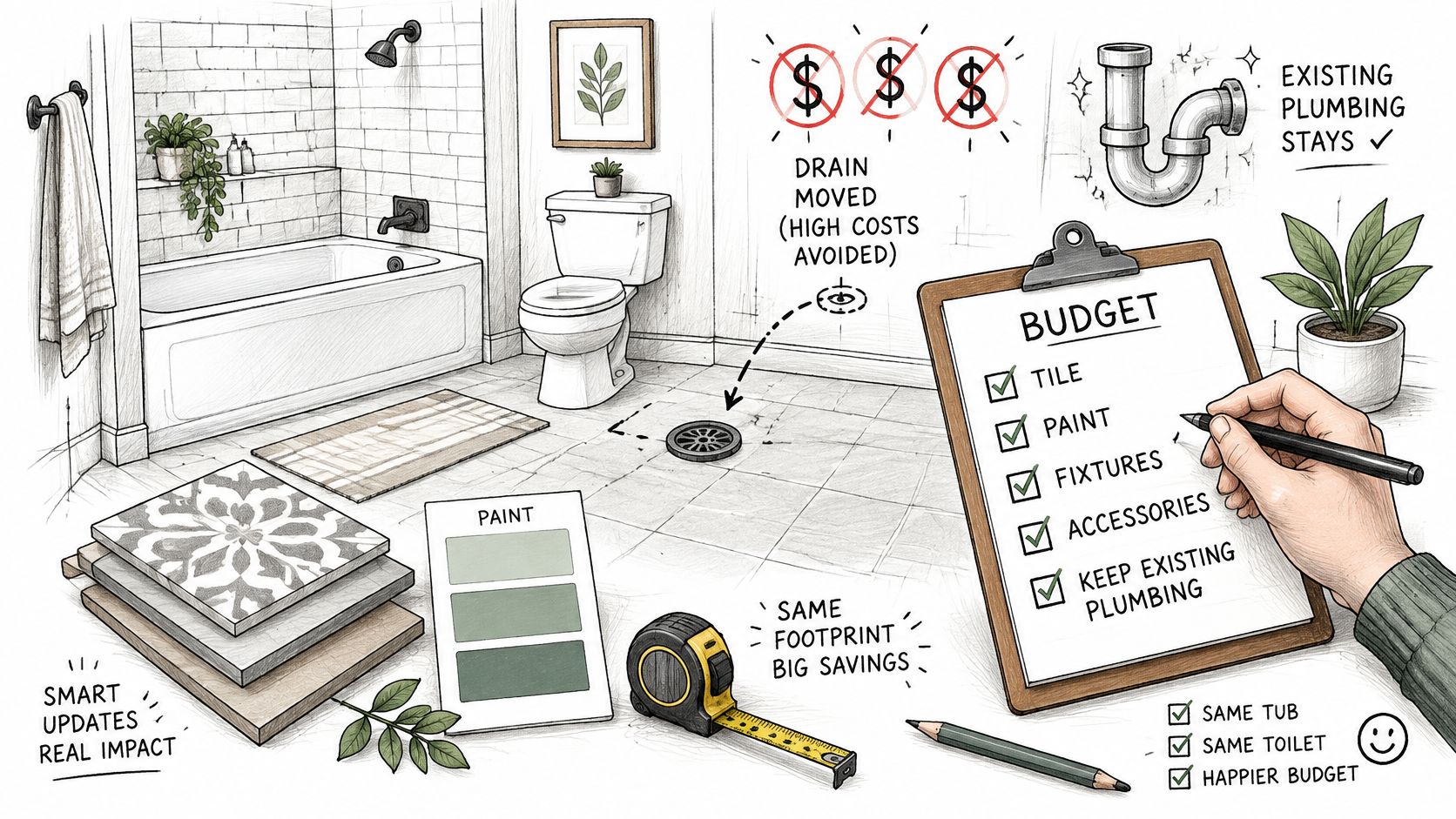
Four cuts return the most money per dollar of risk removed, and every one of them reduces labor or material without touching the plumbing layout or the structure.
- Keep the plumbing where it is. Relocating a drain or a supply stack is the largest line item you can avoid, and it pulls a permit, a plumber and a patch job along with it.
- Keep a sound shower or tub. If the pan holds water and the walls aren't soft, reglaze or retile inside the existing footprint instead of rebuilding the enclosure.
- Buy the vanity, not the cabinetmaker. A stock or semi-custom vanity in a standard width with a quartz top costs a fraction of a built-to-fit cabinet and arrives in weeks rather than months. Refacing is worth it only when the cabinet box is solid.
- Choose one mid-range porcelain tile and repeat it. A simple layout in a single tile costs less in material and far less in labor than stone, mosaics or three different accent tiles.
Price the vanity before you fall for it
A stock vanity wins on price only when the room cooperates. Check three things before you order. Width comes first: if the alcove takes a standard size, a flat-pack cabinet fits clean, and if it doesn't, you're paying for filler strips and lost storage. Plumbing comes second: the drawer stack and door swing have to clear the trap and supply lines, because a cabinet that crowds the drain forces rough-in changes that erase the savings. The top comes third: a semi-custom vanity usually ships with a quartz top included, while a stock cabinet often needs a separate counter, so compare the two on total installed price rather than the cabinet tag.
Step up to semi-custom when you need an odd depth or a specific drawer layout. Go built-to-fit only when no standard size fits the room or you're matching existing millwork.
The tiers below show where each level spends its money.
| Element | Budget tier | Midrange tier | Premium tier |
|---|---|---|---|
| Floor and wall tile | Ceramic or porcelain from a value line | Porcelain in a simple layout | Natural stone or custom large-format tile |
| Vanity | Stock flat-pack in a standard width | Semi-custom cabinet with quartz top | Custom built-to-fit cabinet with stone top |
| Faucet and showerhead | Chrome from a value line | Mid-range brand with WaterSense flow rating | Designer brand with thermostatic valve |
| Shower | Keep existing tub or shower, reglaze the surface | New tile in the existing footprint | Frameless glass and custom layout |
| Lighting and fan | Replace fixtures in existing boxes | LED vanity bar and humidity-sensing fan | Recessed and zoned lighting with new circuits |
Cheap to buy is not cheap to own
Replacement cost decides where the value line is safe. A faucet, showerhead or vanity light swaps out in an afternoon, so the budget pick is a reasonable bet on anything you can reach. The math flips on anything buried: a shower valve body behind tile, a fan motor wired into the ceiling, a trap crowded behind drawers. A cheap valve that can't be serviced without opening the wall turns a small saving into a demolition bill. Order those parts before tile work starts, while the walls are still open and the upgrade is free.
Before you commit to a waterproofing method or a repair, our bathroom waterproofing guide walks through what has to be in place under the tile.
Cut scope on finishes and layout first. Protect the budget for anything you'd have to demolish to reach.
DIY or Hire a Pro for Each Bathroom Task
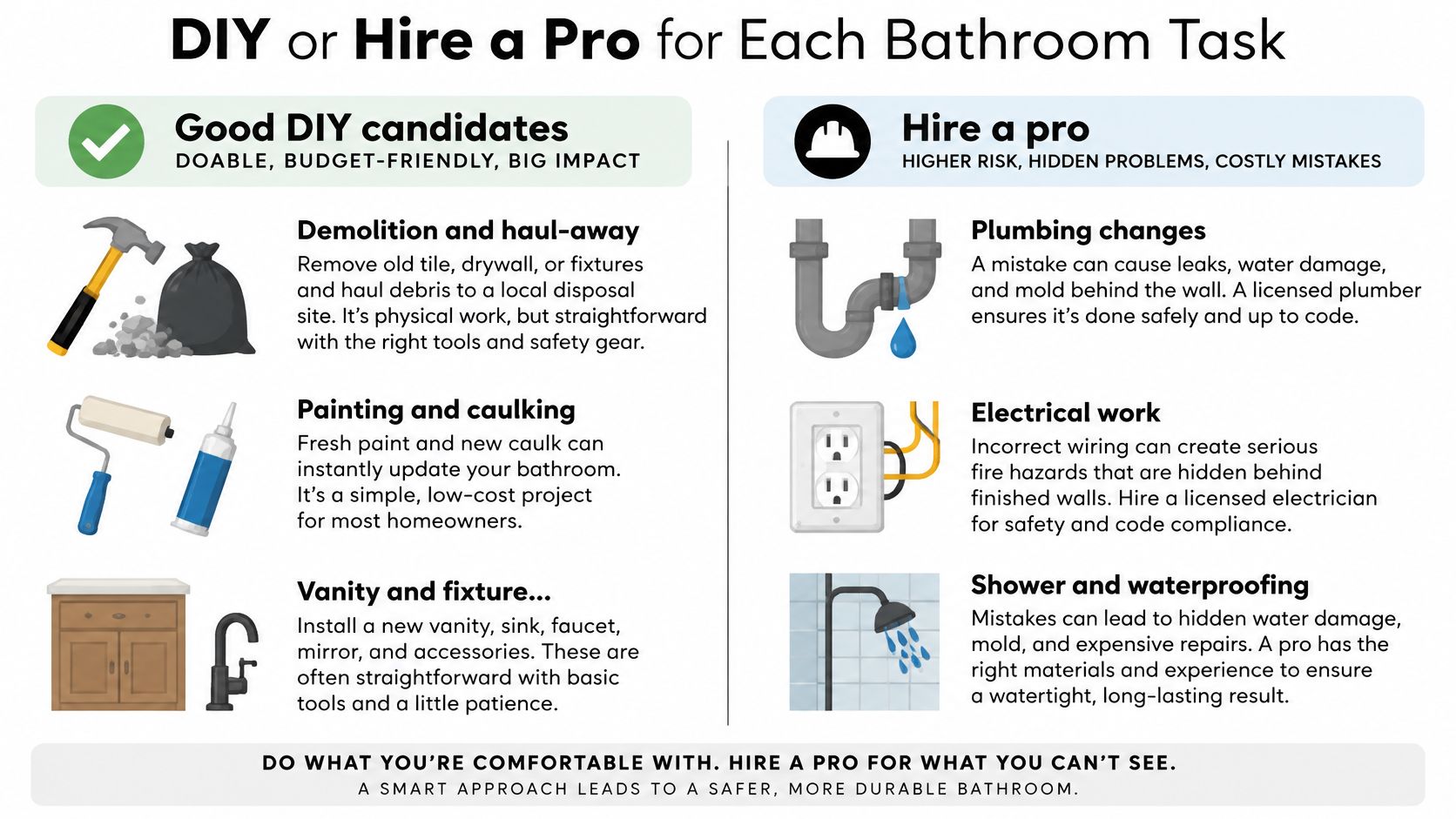
The dividing line isn't difficulty. It's visibility. A task belongs to you when a mistake shows up immediately and costs an afternoon to fix. It belongs to a licensed pro when a mistake hides behind a finished wall and shows up as a stain on the ceiling below.
| Task | DIY-friendly? | Why | Hire a pro when |
|---|---|---|---|
| Demolition and haul-away | Yes, with protection | Low skill, high labor | Only if a lead or asbestos test is positive |
| Painting and caulking | Yes | Forgiving and low risk | Moisture behind walls needs investigating first |
| Vanity and fixture install | Yes, with care | Standard connections | Supply lines are old or need rerouting |
| Tile setting and grout | Partly | Visible results, long learning curve | Large-format tile or complex layout |
| Waterproofing and shower pan | No | Failure hides behind the tile | Always, because hidden water damage is costly |
| Plumbing relocation | No | Pressure and code risk | Always, usually with a permit |
| Electrical and new circuits | No | Fire and code risk | Always, with a licensed electrician |
| Ventilation duct | Partly | Venting outdoors and code compliance | Duct must route through the structure |
What you can safely own
Demolition pays you back in professional hours, as long as you protect the floors, cap the water, and bag the debris instead of stacking it in a hallway. Painting, caulking and hardware swaps are the other reliable wins. Tile is the trap: it looks like a weekend skill and behaves like a three-project skill, and a lippage problem on large-format porcelain can't be sanded out.
What to put in writing for a pro
Waterproofing, pan construction, any plumbing relocation and every new circuit go to licensed trades. In a pre-1978 building, test for lead paint and asbestos before demolition starts, and use a certified firm if either test comes back positive. We work as an EPA Lead-Safe Certified Firm with dust containment on occupied homes, because a renovation in an older Bronx or Westchester house disturbs materials that were installed long before anyone worried about them.
Ask for line-item quotes rather than a lump sum so each trade has a visible price, and check credentials before you compare numbers. Our guide to hiring a licensed contractor in NYC covers the license, insurance and permit questions worth asking every bidder.
Mark your own tasks and the pro tasks separately. Then do the demolition and the painting yourself and spend the difference on waterproofing.
Pay Back Efficiency Upgrades Before You Buy
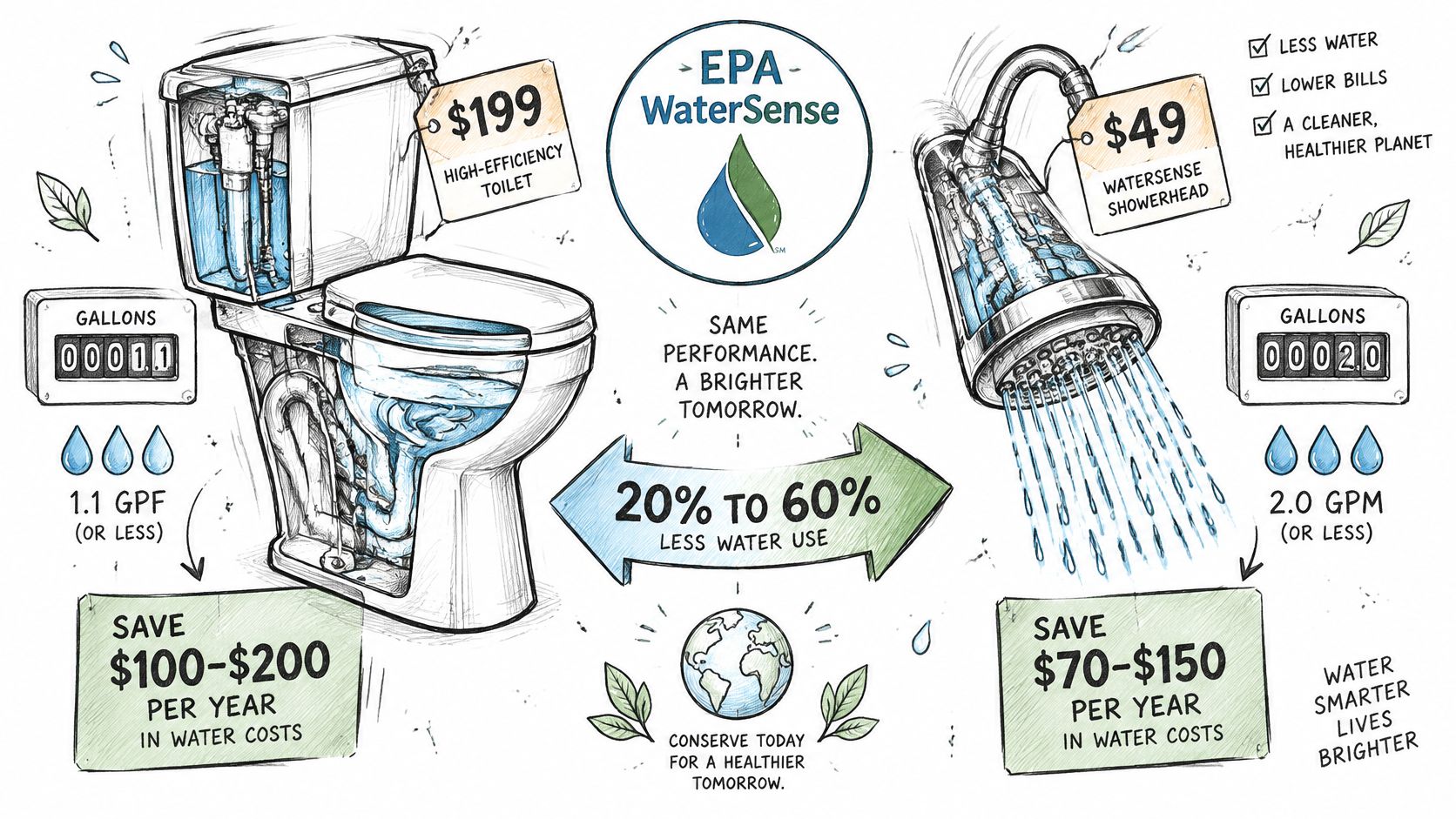
Buy the fixture on operating cost rather than sticker price. The test is one division: extra upfront cost divided by annual savings equals years to payback. When that number falls inside the time you expect to stay in the home, the upgrade pays. When it runs past your timeline, buy the midrange version and put the difference into waterproofing.
The annual savings figure needs four inputs, and you already have all of them.
- Your water rate: take the total charge on a winter bill and divide by the gallons used, so irrigation and summer filling don't distort it.
- Household size: more people means more flushes and showers, which shortens payback.
- Bathroom usage: a hall bath used by guests sits idle and never pays back a premium fixture.
- Fixture age: a toilet installed before the 1990s is where the savings concentrate.
Test the feel before you trust the label
Efficiency anxiety is real and mostly about showerheads. Modern low-flow heads use aeration, a turbine, or larger droplets to hold pressure at lower volume, and the feel of the shower depends more on head design and valve than on the flow number alone. Run the head on a showroom display, hold your hand at the distance you stand, and check whether the spray pattern covers your shoulders. A head that feels weak in the showroom will feel weak at home.
Run the math on one fixture
Take the toilet, since it is the easiest savings to isolate on a bill. Price the premium, read the toilet's share of your winter water charge, and divide.
| Step in the test | Figure for this bath | Where it comes from |
|---|---|---|
| Extra upfront cost | $200 | WaterSense model vs the builder-grade toilet on the shelf |
| Annual savings | $40 per year | The toilet's share of your water rate from the winter bill |
| Years to payback | 5 years | $200 divided by $40 |
| Stay-in-home test | Keep if you plan to stay past year five | Your own timeline for the property |
Five years to break even is a fair deal in a home you plan to keep, and a poor one in a rental you will sell next spring. A faucet aerator costs little enough that the same division clears it almost immediately, while a premium toilet is where the formula earns its keep. Run that arithmetic on your own bill before you choose.
Confirm a Written Scope Before You Commit
A lump-sum quote hides the waterproofing and permit lines. The written scope turns three bids into the same job priced three ways, and it sets the rule for the day demolition opens a wall and finds a broken drain.
What the scope must name
- Scope level and room size, stated in the document, so each contractor prices the same benchmark row from the cost section under the same assumptions.
- Separate line items for waterproofing, substrate, tile, vanity, fixtures, ventilation, electrical and permits.
- Who pulls the permits, and whether co-op or condo alteration approval and any landmark requirements are included in the timeline.
- Protection and cleanup, including dust containment, daily cleanup and lead-safe practice in a pre-1978 building.
- Hidden conditions, in writing: who pays if the subfloor is rotted or the drain is broken once the tile comes up, and who holds the contingency.
- Schedule and payment milestones, tied to completed phases rather than to the start date.
A useful scope can fit on one page:
| Line | What the bid should state |
|---|---|
| Waterproofing | System used, inspection point and warranty term |
| Substrate | Board or underlayment specified, plus the unit price if rotten plywood is found |
| Tile | Setting material, grout, layout labor and disposal |
| Vanity and fixtures | Allowance or exact models, installation and shutoff work |
| Ventilation and electrical | Fan, duct route, switching, lighting work and permit coverage |
| Permits and approvals | Filings included, fees separated and who schedules inspections |
| Cleanup | Protection path, daily cleanup and debris removal |
Compare three bids on that same written scope, line by line. A total far below the benchmark row usually means waterproofing, ventilation or permit fees were left out, and those come back as change orders. A total far above it needs a written reason tied to access, building requirements, structural repair or material tier. Fixed pricing only means something after a site walkthrough, so ask what changes a number and get the answer in writing.
Send the identical packet to three contractors this week and require line-item prices by a stated date. Choose the bid that prices every line and states its exclusions before demolition.
Excellent Home Improvement handles bathroom renovations across the Bronx, Westchester and the five boroughs, from powder room refreshes inside an existing layout to full gut work with code-compliant waterproofing, ventilation and tile. If you're weighing a phased plan against a single-stage renovation, we'll price both against a written scope after a site walkthrough, so the numbers you compare are real. Visit Excellent Home Improvement to start with a scope review and a fixed-price proposal.