10 Bathroom Renovation Tile Ideas for Every Style
Explore 10 bathroom renovation tile ideas for walls, floors, showers, accents, grout, waterproofing, and easy long-term maintenance.
By Excellent Home Improvement

The prettiest bathroom tile isn't automatically the right tile. A glossy handmade surface may look excellent on a mood board but become difficult to clean on a shower floor. A large-format slab can reduce grout lines, yet it also demands a flatter substrate, careful handling, and an installer who understands wet-area detailing. A dramatic dark wall may suit a spacious penthouse, but it can make a compact bathroom feel enclosed if the lighting and supporting finishes aren't planned with it.
Good bathroom renovation tile ideas begin with the room's job. Evaluate each choice by location, moisture exposure, available space, substrate condition, grout upkeep, lighting, slip resistance, and installation complexity. Tile remains a dependable foundation because homeowners continue to choose it for wet areas. Houzz reported that 87% of renovating homeowners selected tile for shower flooring and 83% selected it for shower walls in its 2024 U.S. Bathroom Trends Study.
The ten ideas below move from the systems that protect a bathroom to formats, patterns, decorative finishes, and complete shower concepts. Each one pairs the visible design decision with the work behind it. For NYC-area renovations, Excellent Home Improvement can coordinate design, sourcing, waterproofing, and precision tile setting where the project requires one team to manage the details.
Table of Contents
- 1. Large Format Porcelain Tiles
- 2. Subway Tile in a Brick Bond
- 3. Mosaic and Penny Round Accents
- 4. Herringbone Layouts
- 5. Marble and Natural Stone Tile
- 6. Wood-Look Porcelain Planks
- 7. Waterproof Cement Board and Membrane Systems
- 8. Patterned Encaustic and Cement Tiles
- 9. Walk-In Showers with Glass and Minimal Grout
- 10. Matte Black and Charcoal Tiles with Warm Metals
- Top 10 Bathroom Tile Ideas, Comparison
- Turn Inspiration Into a Tile Plan That Lasts
1. Large Format Porcelain Tiles
Large-format porcelain creates a calm, continuous surface that can make a compact bathroom feel less fragmented. Formats such as 12-by-24 and 24-by-48 inches reduce the number of grout joints across walls and floors, which suits minimalist Manhattan condos, open NYC loft bathrooms, and clean-lined brownstone renovations in Brooklyn or the Bronx.
Porcelain also gives you a broad design range. Stone-look surfaces can provide marble or limestone character without the same maintenance demands as many natural stones, while warm beige, greige, and soft gray finishes work with wall-mounted sinks, floating vanities, and simple mirrors. On shower walls, a large tile can carry veining vertically or horizontally, depending on whether you want to emphasize height or width.
The installation system matters
Oversized tile shows imperfections in the wall or floor. The substrate should be leveled to within 1/8 inch over 10 feet before installation, or the tile may rock, leave uneven edges, or develop lippage. The installer also needs a suitable thin-set mortar, the correct notched trowel, consistent spacers, and a layout that accounts for plumbing penetrations, niches, doors, and corners.
Practical rule: Fewer grout lines don't compensate for a poorly prepared substrate. Spend time on flatness before choosing the tile size.
Plan the layout before ordering. Centering a full tile or a deliberate joint on the most visible wall usually looks better than leaving narrow slivers at both sides. If the tile will cover a floor with underfloor heating, confirm compatibility with the heating system and the selected setting materials. Porcelain tile for bathroom renovations can be especially effective when the design calls for a durable, low-clutter finish, but the format still needs an experienced installation plan.
2. Subway Tile in a Brick Bond
Subway tile remains useful because it can move between periods and styles without forcing the rest of the bathroom into a fixed theme. A 3-by-6 or 4-by-8-inch rectangular tile in a traditional brick bond can support a pre-war co-op bathroom, a renovated NYC townhouse with industrial references, or a contemporary loft with modern plumbing fixtures.
The familiar format also helps control visual risk. White ceramic or porcelain creates a bright envelope, while muted green, blue, teal, charcoal, or warm cream gives the same layout a more individual character. Matching grout preserves a quiet, traditional appearance. A contrasting grout makes every joint visible and gives the wall a more graphic, contemporary quality.
Where the classic format needs care
Subway tile is straightforward in a grid, but the grout and edge treatment determine how it ages. In a shower, use a grout system selected for the exposure and the manufacturer's instructions. Epoxy or urethane-based grout can offer greater stain resistance and easier cleaning than standard cement grout, but it requires careful installation and isn't automatically the best answer for every application.
Seal compatible grout after installation, then maintain it according to the product instructions rather than relying on a fixed routine. A matching grout color hides minor discoloration better than a sharply contrasting one. If you want the room to feel taller, consider a vertical stack, herringbone variation, or a narrow decorative band that draws the eye upward.
A Westchester Colonial bathroom can use subway tile with a mosaic floor and traditional trim, while a Brooklyn loft can pair the same wall format with black fixtures and a floating wood vanity. The material is familiar. The surrounding decisions make it current.
3. Mosaic and Penny Round Accents
Mosaics work best when they give a bathroom a focal point without covering every surface in competing detail. Penny rounds, small squares, hexagons, and glass mosaics can define a shower floor, frame a niche, mark an accent wall, or create a border behind a vanity. In a Manhattan penthouse shower, a small reflective mosaic can catch light. In a Bronx transitional bathroom, a penny tile floor can provide a vintage reference without requiring period fixtures throughout the room.
Small formats offer practical advantages in areas that need several changes of plane. More grout joints allow the surface to follow a shower floor slope more easily than a rigid large tile. They can also add visual texture and underfoot separation, although the grout still needs proper cleaning and maintenance.
Use the accent where people can see it
Mosaic sheets make installation more efficient, but mesh-mounted pieces can reveal alignment errors if sheets aren't blended carefully. The installer should stagger sheet joints, check the pattern from multiple viewpoints, and avoid placing a visible seam directly through a niche or prominent corner. Individual pieces may also vary in shade, especially with glass or handmade-look products, so open several sheets before setting them.
Keep the rest of the room quieter. A neutral large-format wall tile paired with a mosaic shower floor gives the floor a purpose without overwhelming a small room. An accent behind the vanity can work well when the shower already has enough visual activity.
Small tile creates detail, but grout becomes part of the design. Choose the grout color and cleaning strategy before the sheets go on the wall.
Use epoxy grout where the product and installer are appropriate, particularly in locations exposed to staining. If glass mosaic is going into a shower surround, test it under the planned lighting first. Reflections that look lively in a showroom can become visually busy beside mirrors and polished fixtures.
4. Herringbone Layouts
Herringbone adds movement without requiring a complicated tile shape. Rectangular tiles are set at alternating angles to create a repeated V pattern, making the floor feel more directional and giving a simple material a refined appearance. The pattern suits marble floors in luxury Manhattan bathrooms, oak-look porcelain in Westchester master baths, glazed ceramic in Brooklyn brownstones, and restrained monochromatic schemes in modern Bronx renovations.
The strongest herringbone installations usually control the color. A neutral tile with a simple grout lets the geometry provide the drama. If both the tile surface and grout are high contrast, the floor can dominate a small room and compete with the vanity, mirror, and plumbing fixtures.
Precision starts before the first cut
Begin the layout from the center or from the most important sightline, then work toward the edges. A centered pattern generally feels more intentional than one that begins with a partial diagonal at the doorway. The installer needs accurate angle settings on a quality wet saw, careful edge cuts, and a plan for transitions at thresholds and drains.
Herringbone also consumes more planning than a straight lay. That affects labor, sequencing, and the amount of material required for cuts. It's a strong choice when the floor is the feature, but it may be unnecessary on every wall.

Pairing a herringbone floor with a straight grid on the walls creates contrast without visual disorder. In a narrow bathroom, the direction of the pattern can support the room's proportions, but the installer should verify the effect with a dry layout before setting tile. A small room has fewer places to hide an awkward cut.
5. Marble and Natural Stone Tile
Natural stone gives each surface variation that manufactured tile may imitate but cannot reproduce exactly. Marble, limestone, travertine, and granite can bring veining, mineral movement, and a sense of permanence to a Manhattan bathroom, a Westchester estate, or a brownstone renovation preserving historic details.
That character comes with responsibilities. Stone can absorb moisture and staining, and polished surfaces may be unsuitable underfoot in wet areas. A honed or tumbled finish generally provides a more practical starting point for floors than a highly polished one, but the specific stone, finish, slope, and maintenance plan still matter.
Reserve luxury material for the right location
Marble can be especially effective in a shower niche, vanity backsplash, or feature wall, where its veining receives attention without placing the entire wet area under demanding maintenance. For shower floors, porcelain or a suitable granite may offer a more manageable alternative than marble. Limestone and travertine also require product-specific sealing and cleaning products that won't etch or damage the surface.
Explore natural stone tile options only after confirming where the material will be installed and how the household will care for it. The installer should protect the stone during setting, prevent mortar and grout from staining the surface, and follow the sealer manufacturer's directions. Seal the material after installation when required, then maintain it on the schedule appropriate to the stone and the bathroom's use.
A simple grout color usually supports natural veining better than a competing contrast. Let the stone provide the variation, then keep the fixtures, paint, and accessories controlled.
6. Wood-Look Porcelain Planks
Wood-look porcelain brings warmth to a bathroom without putting real hardwood in a wet environment. Plank formats can connect a bathroom visually to an adjacent hallway, kitchen, or open-plan living area, which is useful in NYC apartments where one continuous palette can make several compact spaces feel more related.
The best products avoid an overly repetitive printed pattern. Look for varied grain faces, restrained color shifts, and a matte finish that feels appropriate underfoot. Warm oak tones suit transitional Bronx bathrooms and Westchester ranch modernizations, while darker walnut-inspired colors can work in a loft if the room has enough light.
Treat the floor as a wet assembly
The porcelain surface is water resistant, but the complete installation still depends on sound waterproofing, movement accommodation, properly sealed penetrations, and correctly detailed fixture areas. Water can travel below tile through joints, edges, or plumbing openings when the underlying system is incomplete. The tile itself doesn't replace waterproofing.
Avoid laying every plank in a predictable repeating stair-step. A planned random layout usually looks more like wood, although the installer should follow the product's limits for offsetting long planks to reduce lippage. Use a grout tone close to the tile to keep the joints quiet, and plan cuts so the most visible areas receive the strongest full pieces.
A bathroom that opens directly onto a wood-look hallway can carry the plank across the threshold for continuity, but the transition still needs a durable, serviceable detail. Confirm that the adjacent floor heights, door swing, and waterproofing edge all work before installation begins.
7. Waterproof Cement Board and Membrane Systems
Tile is only the visible layer of a bathroom. Behind it, the waterproofing assembly controls whether shower water stays where it belongs. Cement board, sheet membranes, liquid-applied membranes, edge profiles, drains, fasteners, and sealants must work as one system. In NYC co-ops, condos, brownstones, and homes subject to alteration requirements, incomplete wet-area detailing can create damage long after the tile looks finished.
Drywall alone isn't a suitable substitute for a properly designed wet-area substrate. Waterproofing needs special attention at corners, changes of plane, niches, benches, valve penetrations, and the junction between the shower floor and walls. A shower floor also needs a consistent slope toward the drain, with 1/4 inch per foot as the minimum slope specified in the project plan.
Inspect before the tile hides the work
A licensed professional should verify the waterproofing before tile installation. Photographing the membrane, seams, corners, and pipe penetrations can help document the work for project records, warranty questions, or building approvals. The exact product system matters, so don't mix components casually across manufacturers.
Use a bathroom waterproofing planning resource when comparing cement-board and membrane approaches. The right choice depends on the shower type, substrate, drain, transitions, and local requirements. A waterproofing failure can force demolition of otherwise attractive tile, so saving effort at this stage is a false economy.
8. Patterned Encaustic and Cement Tiles
Patterned cement tiles can turn a vanity wall, shower niche, or floor into the room's defining feature. Moroccan geometry, Mediterranean motifs, and hand-painted designs bring cultural references and personal history into a bathroom, whether the inspiration comes from travel, family heritage, or the character of a neighborhood such as Williamsburg or the Bronx.
The pattern needs room to read. In a small bathroom, covering every wall with a strong motif can make the room feel crowded, especially when the fixtures already have distinct shapes. A better approach is to place the pattern behind the vanity, inside a niche, or on one carefully selected floor area, then support it with a calm subway tile or solid porcelain.
Sealing changes the maintenance plan
Cement tile is porous and can stain if it isn't sealed correctly. Seal it after installation with a product suited to the tile, then follow the manufacturer's cleaning instructions. Acidic cleaners can damage cement-based surfaces, and aggressive scrubbing may wear the finish or alter the appearance.
Grout color deserves a test board. Matching the dominant color in the pattern usually lets the design read as one composition, while an overly bright contrast can outline every tile and make the floor look busier than intended. Ask the installer to dry-lay the pattern, confirm orientation, and identify where cuts will occur before setting begins.
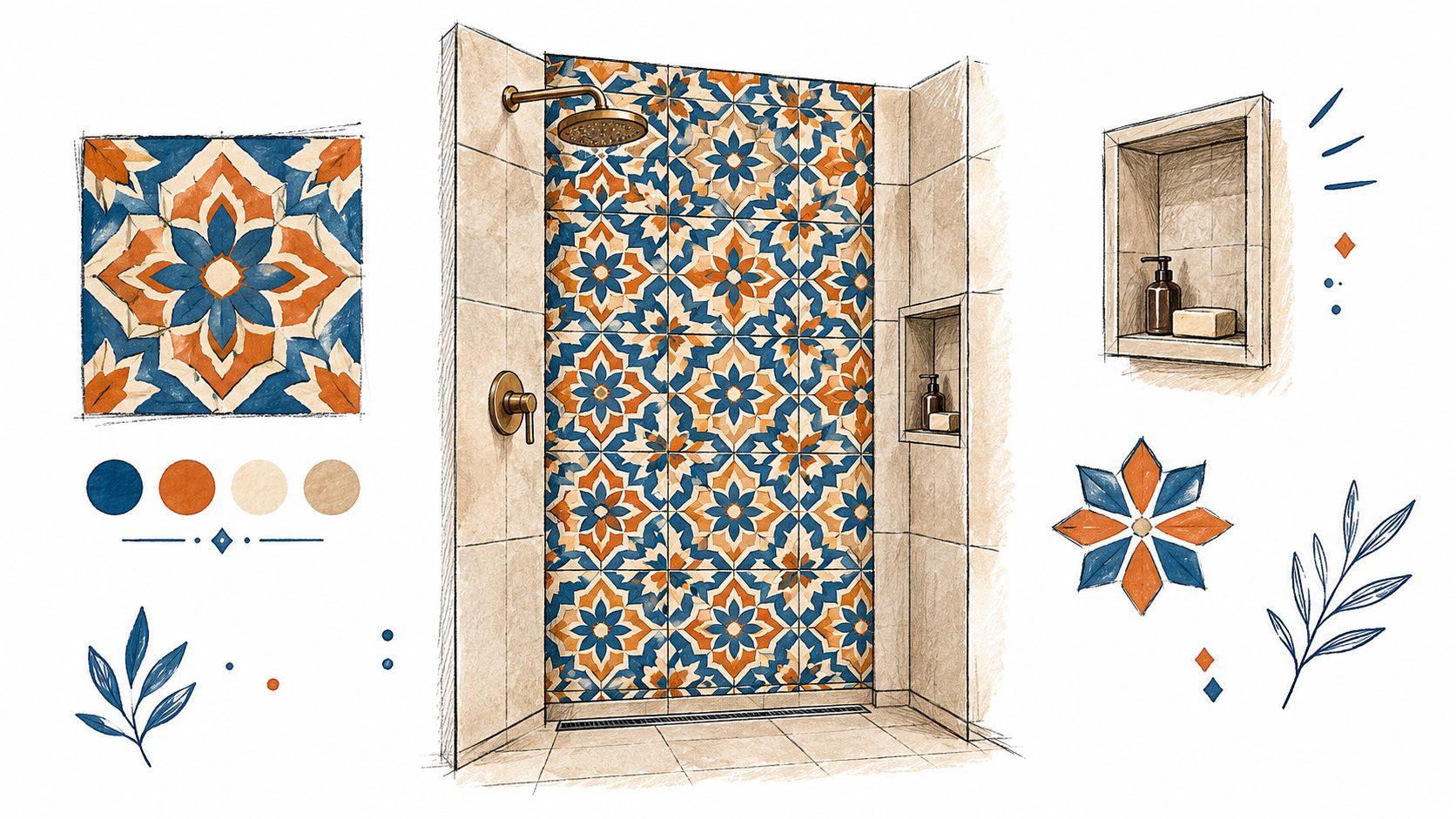
A patterned tile can make a simple vanity feel custom, but the surrounding surfaces should support rather than compete with it. Use warm metals, painted millwork, or a quiet stone top to give the pattern a clear visual frame.
9. Walk-In Showers with Glass and Minimal Grout
A walk-in shower with a frameless or minimally framed glass enclosure can open a compact bathroom visually. The effect depends less on glass alone than on the complete water-management system. The floor needs a consistent fall to the drain, the membrane must extend through the shower area and transitions, and the glass hardware must be positioned after the finished tile levels are confirmed.
Large-format porcelain on the visible shower walls supports the clean envelope many homeowners want. It can reduce grout maintenance, but fewer joints don't eliminate the need for careful waterproofing. In fact, large pieces can make repairs more involved if a valve, niche, or concealed connection ever requires access.
Plan the shower around service and ventilation
A linear or flush drain can support a curbless appearance, but the drain location, framing, slope, and tile layout must be resolved together. The tile around the drain needs to follow the fall without creating sharp lippage or low spots where water remains. A bench and niche should be framed, waterproofed, and sloped correctly, not treated as decorative boxes added after the main work.
Less grout isn't always less risk. It can improve visual calm, but it may require higher-skill handling and make future replacement more demanding.
A niche at eye level can carry a mosaic or complementary stone without interrupting the main wall tile. Good exhaust ventilation protects the finishes and reduces persistent moisture. Lighting, outlets, controls, and mirror placement should be resolved before glass is ordered, because a beautiful enclosure can't fix a poorly planned daily-use layout.
10. Matte Black and Charcoal Tiles with Warm Metals
Dark tile creates a strong architectural background for brass, bronze, or copper fixtures. Matte black and charcoal can suit an industrial Brooklyn loft, a luxury Manhattan bathroom, or a contemporary Westchester ensuite, but the palette needs controlled contrast. Without adequate light and reflective surfaces, a very dark compact bathroom can feel smaller and make grooming tasks harder.
Use dark tile where it strengthens the composition. An accent wall behind the vanity, a shower back wall, or a lower wall zone can provide drama without enclosing the entire room. Large-format pieces reduce the visual interruption of grout, while a matte finish generally feels softer than polished black and shows less glare.
Light and maintenance decide whether it works
Layered lighting is essential. Combine effective overhead illumination with clear vanity lighting, then add reflected light through mirrors, pale countertops, or glass. Warm metal fixtures prevent the room from feeling institutional, while light oak, natural stone, or a warm painted vanity can keep the palette from becoming severe.
Dark surfaces can show mineral deposits, soap residue, and dust more readily than a mid-tone tile. Choose a finish that can be cleaned without abrasive products, confirm the grout maintenance requirements, and allow the surface to dry through effective ventilation. Dark grout may hide some discoloration, but it can also reveal light residue.
A dramatic charcoal shower wall paired with a pale floor and warm brass controls often delivers more balance than black tile everywhere. Add greenery or wood accents only where moisture, light, and maintenance conditions support them. The room should look intentional in daylight and remain functional after the decorative lighting is switched on.
Top 10 Bathroom Tile Ideas, Comparison
| Item | Implementation complexity | Resource requirements | Expected outcomes | Ideal use cases | Key advantages |
|---|---|---|---|---|---|
| Large Format Porcelain Tiles (12x24 to 24x48) | High, requires perfectly flat substrate and experienced installers | Higher material cost, precision cutting tools, quality thin-set and leveling | Seamless, modern aesthetic; spaces feel larger; durable and moisture resistant | Small bathrooms, spa-like NYC apartments, walls and floors requiring minimal grout | Fewer grout lines, easy cleaning, long-lasting performance |
| Subway Tile (3x6 or 4x8 Brick Bond) | Low–Medium, forgiving installation and simple layouts | Low cost materials, more grout and grout maintenance | Timeless, versatile finish that suits many styles | Budget renovations, classic/transitional kitchens and bathrooms, historic properties | Affordable, widely available, many layout options |
| Mosaic and Penny Round Tile Accents | Medium–High, labor-intensive placement and many grout joints | Higher labor cost, pre-mounted sheets reduce time; epoxy grout recommended | High-impact, textured accents and artisanal detail | Accent walls, niches, shower surrounds, small focal areas | Custom patterns, strong visual interest, suitable for focal applications |
| Herringbone Layout Pattern | High, precise angled cuts and skilled layout required | Increased waste, longer labor time, accurate cutting equipment | Dynamic, sophisticated pattern that adds perceived width and movement | Feature floors and walls in upscale renovations | High-end appearance, visual flow, masks minor substrate irregularities |
| Marble and Natural Stone Tile | High, specialist handling, careful installation and sealing | Very high material and labor costs, sealing products and skilled stone setters | Luxurious, timeless look that can increase property value | Luxury bathrooms, feature walls, high-end remodels | Unique veining and prestige, premium tactile quality |
| Wood-Look Porcelain Tile (Plank Format) | Medium, standard tile skills with attention to layout to avoid repetition | Moderate material cost, waterproof substrate, compatible with radiant heat | Warm wood-like appearance with waterproof durability and low maintenance | Open-plan apartments, continuity between rooms, bathrooms near living areas | Authentic wood look without water issues, durable and easy to maintain |
| Waterproof Cement Board Installation and Schluter Systems | Medium–High, precise waterproofing to meet code and manufacturer specs | Additional membrane and profile costs, experienced installers, documentation | Code-compliant, long-lasting waterproof assemblies that prevent leaks and mold | All wet areas, curbless showers, co-op/condo projects requiring DOB compliance | Prevents water damage, reduces contractor liability, supports warranties |
| Patterned Encaustic and Cement Tiles (Moroccan, Mediterranean) | Medium–High, careful placement and color coordination; sealing required | High material cost, artisan sourcing, sealing and ongoing maintenance | Bold, personalized aesthetic and strong cultural character | Accent walls, niches, boutique or eclectic homes, focal floors | Unique handcrafted look, strong visual statement and personalization |
| Walk-In Shower with Seamless Glass Enclosure & Minimal Grout | High, precise slope/drain design, waterproofing, and glass installation | High cost for glass, drains, membranes; skilled trades and drainage systems | Spa-like, open shower that maximizes perceived space and accessibility | Small bathrooms needing openness, luxury master baths, aging-in-place designs | Visual spaciousness, accessible curbless entry, showcases tile choices |
| Matte Black and Charcoal Tiles with Warm Metal Accents | Medium, standard installation but requires careful lighting and finish coordination | Moderate–high material and fixture costs; quality lighting and hardware | Dramatic, contemporary luxury look that can be high-impact | Luxury apartments, accent walls, industrial or modern transitional interiors | Sophisticated dramatic palette, hides stains, pairs well with warm metals |
Turn Inspiration Into a Tile Plan That Lasts
Start with the room's wet and dry zones. Shower floors, shower walls, tub surrounds, vanity backsplashes, and general bathroom floors don't face the same moisture, cleaning, or slip-resistance demands. A tile that works beautifully behind a vanity may be a poor choice under wet feet, while a highly textured floor tile may be difficult to clean on a broad shower wall.
Next, confirm the substrate and waterproofing requirements before choosing the finish. Large-format porcelain, subway tile, mosaics, natural stone, wood-look planks, patterned cement tiles, and dark palettes all depend on different installation decisions. Verify wall flatness, floor levels, drain placement, fixture penetrations, movement joints, transitions, and access requirements before the tile order is finalized.
Choose one primary tile first. It usually establishes the room's scale, color, and maintenance burden. Add no more than one or two supporting patterns unless the bathroom is large enough to give each material breathing room. A large-format porcelain wall with a mosaic shower floor is a coherent system. A patterned cement floor, marble niche, glossy accent wall, and high-contrast grout may become a collection of unrelated maintenance tasks.
Grout deserves its own decision. A close match creates a quieter surface and is usually more forgiving visually. A contrasting grout emphasizes the pattern but also makes every joint part of the room's appearance. Select the grout based on the location, cleaning expectations, and installer's experience with the product, not only on a sample board.
Check the finish under real lighting and consider slip resistance where people will stand with wet feet. A polished surface may reflect light attractively but perform poorly underfoot. A small mosaic can help a sloped shower floor conform to the drain, while a large tile may provide the clean wall appearance you want.
Order enough material for cuts, shade variation, breakage, and future repairs. Keep labeled spare pieces in a dry, accessible location. If the project is in a NYC condo, co-op, brownstone, or multifamily property, coordinate design, sourcing, permits or building approvals, waterproofing documentation, and code-compliant installation before demolition begins. Excellent Home Improvement can manage bathroom design, material sourcing, waterproofing, tile setting, fixtures, lighting, and related renovation work under one project scope when professional oversight is appropriate.
Excellent Home Improvement offers NYC-area bathroom renovation support that combines design coordination, tile and natural-stone sourcing, waterproofing, precision setting, fixtures, lighting, and finish work. If you're comparing these bathroom renovation tile ideas for a Bronx, Westchester, or five-borough project, visit Excellent Home Improvement to discuss the room, the installation system, and the next practical step.