Drywall Finishing Rates NYC Pricing Guide 2026
Get current drywall finishing rates in NYC per sq ft and per room, with Level 4 vs Level 5 costs, labor vs materials and sample quotes.
By Excellent Home Improvement
Drywall finishing rates for NYC projects generally fall within $0.85 to $3.50 per square foot for labor and materials, with Level 4 commonly around $1.70 to $3.20 and Level 5 around $1.75 to $3.50, depending on site conditions and the required smoothness. A Level 5 upgrade can therefore carry a modest published per-square-foot premium over Level 4, but the invoice rises when difficult access, critical lighting, extensive sanding, or high-end paint preparation adds labor.
Table of Contents
- Introduction to Drywall Finishing Rates in NYC
- Drywall Finish Levels Explained From Level 0 to Level 5
- Level 4 vs Level 5 Finishing and When the Upgrade Is Worth It
- NYC Drywall Finishing Rate Tables by Finish Level
- Per Room and Whole Home Cost Examples for NYC Apartments
- What Drives Drywall Finishing Costs in NYC
- Labor vs Materials Breakdown and Sample NYC Quotes
- Quick Reference Lookup and Cross References for Drywall Rates
Introduction to Drywall Finishing Rates in NYC
Published national benchmarks place combined drywall finishing labor and materials between $0.85 and $3.50 per square foot. That range is useful for orientation, not for pricing a New York City invoice. In NYC, the more informative question is how much a Level 5 specification adds over Level 4 when glossy paint or critical lighting will expose minor surface variation. The premium depends on skim-coat coverage, sanding time, wall condition, and access, so a single national rate can understate the final scope. See the current drywall finishing cost benchmark for the published national range.
Apartment logistics often move an ordinary scope toward the upper end of its rate band. Crews may work through elevators and narrow corridors, protect lobbies, finish occupied rooms, and meet building delivery windows. Co-op and condo requirements can add containment, daily cleanup, insurance paperwork, and coordinated access. The measured area stays the same, but productive labor hours increase.
What the rate includes
Finishing usually begins after the drywall is hung. It can cover joint taping, compound over seams and fasteners, several fill coats, sanding, and an all-over skim coat for Level 5. Hanging remains separate unless the proposal combines board installation and finishing.
Read each quote against three practical checks:
- What surface is being measured? Wall and ceiling areas are measured separately from apartment floor area.
- What finish level is specified? “Standard finish” does not define the surface expected for glossy paint or strong raking light.
- Are materials and preparation included? Joint compound, tape, sanding, dust control, primer, and repairs may appear as separate line items.
A defensible NYC budget starts with the finish level, then adjusts for access, existing conditions, room geometry, and paint requirements. The rate tables and examples that follow should help you test whether a quoted per-square-foot figure matches the actual work.
Drywall Finish Levels Explained From Level 0 to Level 5
Six finish levels, from Level 0 through Level 5, define how much joint treatment and surface preparation a drywall surface receives. The finish level is the main technical variable behind drywall finishing rates. More compound, sanding, and surface coverage increase labor as the required appearance becomes more uniform. The scope and typical applications follow GA-214-style industry guidance, as outlined in this drywall finish-level reference.
The six levels in plain English
- Level 0: No finishing is performed. The board remains exposed, which suits temporary construction or areas that another trade will cover.
- Level 1: Tape is embedded at the joints, while tool marks and uneven areas remain acceptable. It fits concealed spaces where appearance is not a design requirement.
- Level 2: A coat covers the tape and fasteners. This level commonly serves areas behind tile or inside utility spaces, rather than finished painted walls.
- Level 3: Additional compound and sanding reduce visible tool marks. It can support heavier texture, but it is not the normal specification for a smooth residential wall with light sheen.
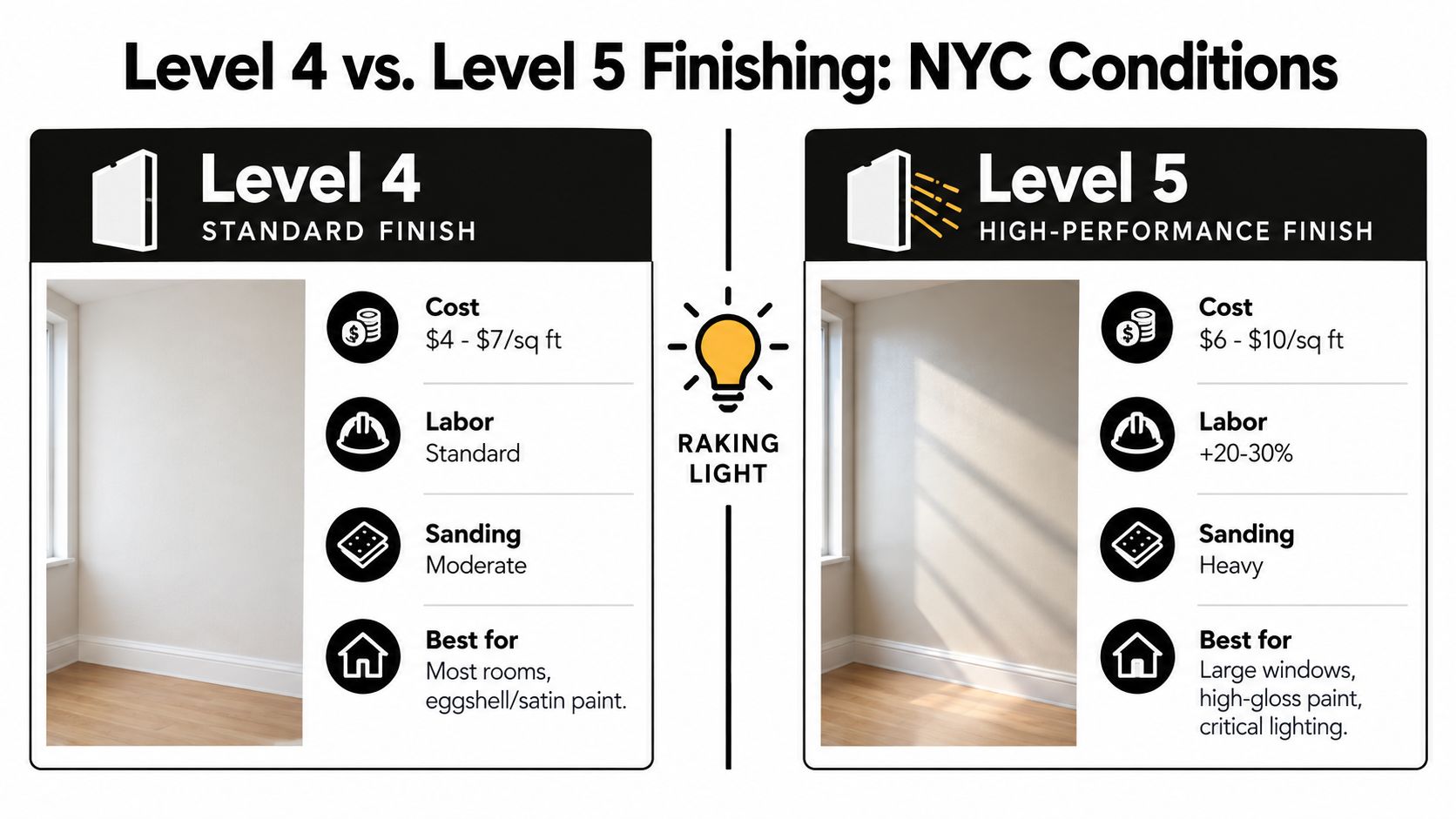
- Level 4: This is the standard residential paint-ready finish. It suits most living areas with flat, eggshell, or satin paint when lighting is not unusually severe.
- Level 5: A skim coat covers the entire surface after the Level 4 process. It provides a more uniform base for glossy paint, large windows, and low-angle, or raking, light.
Level 5 adds treatment to the field of the wall, not only another pass over the seams. Subtle variations in the drywall paper can remain visible after paint, especially where light travels across the surface.
For a utility room, Level 2 may meet the scope. A typical bedroom usually calls for Level 4. A living room with strong directional light may justify Level 5, particularly when the paint has a higher sheen. The lighting plan and final paint specification should be set before the contractor prices the finish.
Level 4 vs Level 5 Finishing and When the Upgrade Is Worth It
Level 4 is the practical default for most residential walls. It creates a paint-ready surface after joint treatment and sanding, and it usually handles ordinary lighting with flat, eggshell, or satin paint. Level 5 targets a narrower problem: surface variation that becomes visible when light travels across the wall instead of striking it directly.
Published ranges place Level 4 labor and materials around $1.70 to $3.20 per square foot, compared with $1.75 to $3.50 or higher for Level 5, according to the contractor cost guide covering drywall finishing. Another pricing reference puts finish-only labor around $0.55 to $1.50 for Level 4 and $0.90 to $2.80 for Level 5. The comparison shows why a NYC Level 5 premium can vary widely on glossy-paint and critical-lighting interiors. One quote may include a complete labor-and-materials package, while another prices only the added finishing work.
A practical upgrade test
Choose Level 5 when several of these conditions apply:
- Raking light: Large windows, wall-washing fixtures, or long corridors direct light across the surface.
- Glossy paint: Higher sheen reflects irregularities instead of softening them.
- Large uninterrupted walls: Broad surfaces give shadows and ridges more room to read.
- Feature ceilings: Ceilings can expose variation as daylight changes.
- High visual expectations: The room is intended to look uniform from multiple viewing angles.
Stay with Level 4 in bedrooms, secondary hallways, and ordinary rooms where the paint and lighting won't emphasize small surface changes. In a NYC apartment, selective specification usually controls the premium more effectively than applying Level 5 everywhere. A homeowner may use Level 5 in the main living room and dining area, then specify Level 4 elsewhere.
Estimator's rule: Specify the finish by room and lighting condition, not by apartment-wide habit.
NYC Drywall Finishing Rate Tables by Finish Level
NYC budgeting depends on separating production labor from the full finishing package. Published pricing references place overall drywall finishing around $0.85 to $3.50 per square foot, with Level 4 commonly at $1.70 to $3.20 and Level 5 at $1.75 to $3.50 or higher. For labor-only production, Level 4 runs about $0.25 to $0.45 per square foot, while Level 5 runs about $0.40 to $0.65. These are comparison bands, not a substitute for a site-specific proposal.
| Finish level | Labor only per sq ft | Labor and materials per sq ft | Typical use case |
|---|---|---|---|
| Level 0 | Scope-specific | Scope-specific | Temporary or concealed board |
| Level 1 | Scope-specific | Scope-specific | Concealed areas and fire-resistance applications |
| Level 2 | Scope-specific | Scope-specific | Behind tile and utility areas |
| Level 3 | Slightly below the Level 4 production band | Within the broader finishing range | Heavier texture or limited-visibility areas |
| Level 4 | $0.25 to $0.45 for labor-only production | $1.70 to $3.20 | Standard paint-ready residential rooms |
| Level 5 | $0.40 to $0.65 for labor-only production | $1.75 to $3.50 or higher | Critical lighting, glossy paint, and highly uniform walls |
Piece-rate industry references place production finishing labor between $0.25 and $0.45 per square foot for Level 4. A separate labor-cost discussion places finish-only work at $1,200 to $3,000 per 1,000 square feet of wall area and reports skilled tapers completing about 100 to 150 square feet per hour under ideal conditions. Broader crew references list output around 150 to 250 square feet per hour per worker. Those production differences help explain the NYC premium from Level 4 to Level 5: skim coating, additional sanding, inspection, and correction consume more labor, especially under glossy paint or critical lighting.
How to apply the table
Measure the actual wall and ceiling surfaces included in the scope. Do not multiply apartment floor area by a finishing rate unless the contractor explains the conversion. Confirm whether the quote covers finish-only work or also includes hanging, repairs, primer, containment, and final cleanup.
A Level 5 allowance should be tested against the room's lighting and paint specification. For glossy-paint interiors and walls exposed to critical lighting, the upper end of the Level 5 band can be reasonable because minor surface variation remains visible. Level 4 may fit ordinary rooms with flatter paint and less demanding light.
For a second quote check, compare the written scope with published renovation pricing information. A quote near the top of a band may include difficult access, extensive patching, or Level 5 preparation. A lower figure may exclude sanding, materials, or surface correction.
Per Room and Whole Home Cost Examples for NYC Apartments
Per-square-foot math becomes useful only after you measure the right surface. For a rectangular room, estimate wall area by adding the lengths of all walls and multiplying by ceiling height, then subtracting substantial openings. Add the ceiling separately if it's included in the scope. Closets, soffits, returns, alcoves, and unusually high ceilings increase the measured surface or the labor needed to finish it.
A room-level calculation
Suppose a bedroom has a measured finish area of 500 square feet. Applying the published labor-and-materials bands produces these planning figures:
- Level 4: 500 × $1.70 to $3.20, or $850 to $1,600.
- Level 5: 500 × $1.75 to $3.50, or $875 to $1,750.
Those are arithmetic applications of the benchmark, not guaranteed NYC bids. A room with clean new board, clear access, and ordinary paint may sit nearer the lower portion of the range. A room with repairs, occupied-home containment, difficult elevator access, or strong window light can move upward.
A living room with 800 square feet of finish area would calculate as follows:
- Level 4: 800 × $1.70 to $3.20, or $1,360 to $2,560.
- Level 5: 800 × $1.75 to $3.50, or $1,400 to $2,800.
Apartment-scale planning
For a full apartment refresh, measure each room rather than applying one rate to the floor plan. An apartment with 2,000 square feet of finished wall and ceiling surface would produce a Level 4 planning band of $3,400 to $6,400, while Level 5 would produce $3,500 to $7,000, using the same published ranges.
These examples exclude any separate hanging, demolition, framing, major substrate repair, painting, or permit-related work unless the proposal says otherwise. They also show why a small per-square-foot difference can become meaningful across a whole apartment, particularly when Level 5 is specified everywhere instead of only in the rooms where light and sheen demand it.
What Drives Drywall Finishing Costs in NYC
Two apartments with the same measured surface can receive very different quotes. The difference usually comes from production conditions and scope clarity, not from the arithmetic alone.
Seven invoice drivers
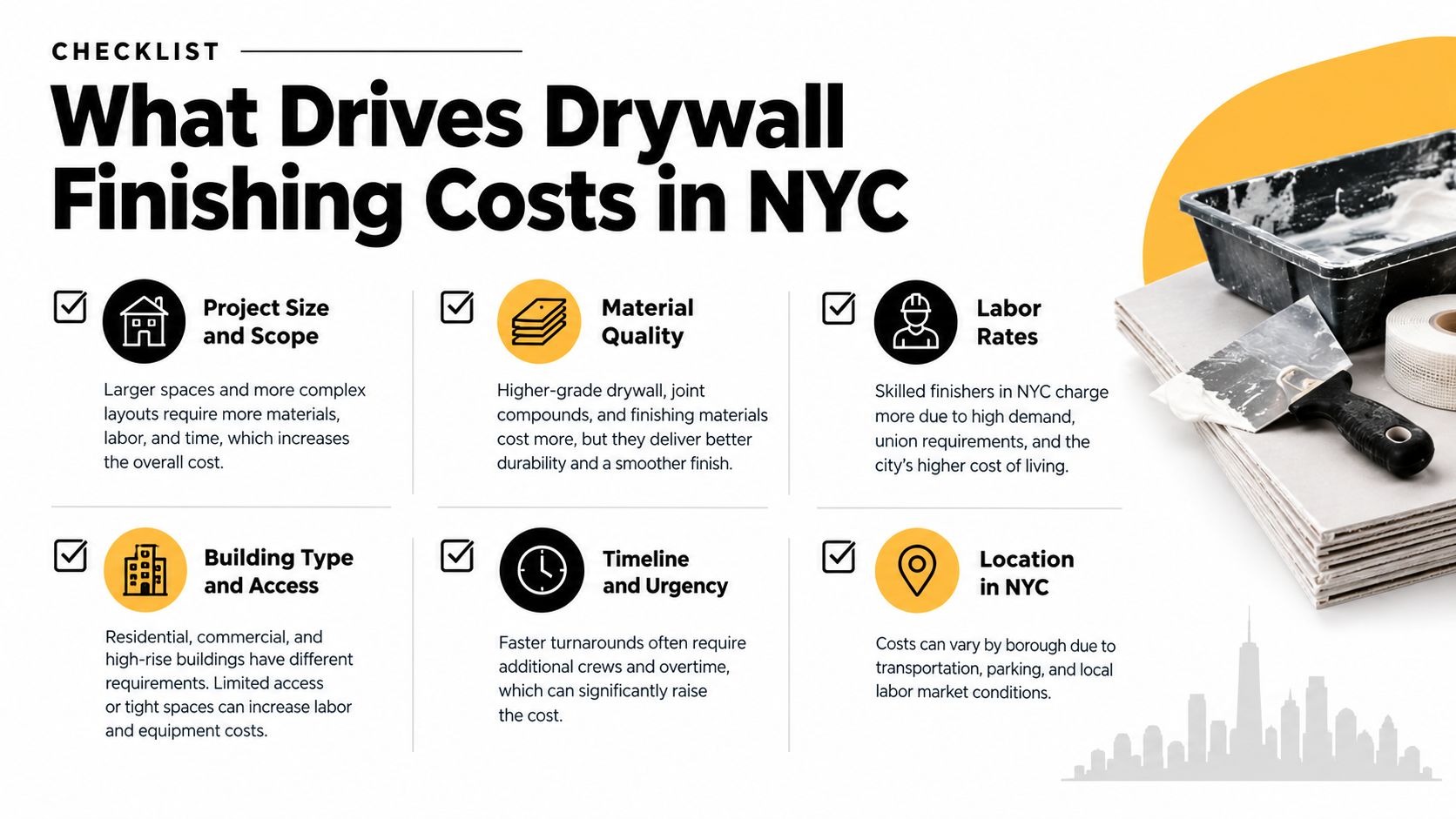
Finish level. Level 4 concentrates compound and sanding at joints and fasteners. Level 5 adds a skim coat across the wall field, increasing labor intensity. The rate table above shows how labor-only production bands widen between the two.
Existing surface condition. New board, damaged board, old plaster transitions, exposed fasteners, and uneven patches require different preparation. A contractor who must feather repairs across a broad area may spend more time than the raw patch size suggests.
Access and containment. Elevator reservations, long carries, stairs, occupied rooms, floor protection, plastic barriers, and dust cleanup all affect crew time. NYC access isn't a footnote. It belongs in the written scope.
Building requirements. Co-op and condo alteration agreements can dictate work hours, insurance paperwork, protection standards, and debris handling. Those administrative and logistical requirements can place a quote toward the higher end of its band.
Paint sheen and lighting. Glossy paint and low-angle light expose surface variation. If the design includes either, the finish specification should be chosen before the drywall work begins.
Patch versus full-room work. Small repairs may require setup, protection, drying, sanding, and color preparation that don't scale neatly to the patch's area. Full-room work spreads setup across more surface.
Schedule constraints. Compressed access windows and tightly coordinated trades can increase labor pressure. A flexible sequence may allow drying and sanding to proceed efficiently, while a restricted schedule can create additional mobilization.
For a contractor who handles board installation, repairs, and high-level finishing, review the NYC drywall installation service and ask for a line-item scope. You want the proposal to identify the finish level, measured area, access assumptions, sanding standard, containment, and exclusions.
Labor vs Materials Breakdown and Sample NYC Quotes
Labor-only pricing usually covers the crew's work for taping, applying compound, sanding, and possibly skim coating. Labor-and-materials pricing adds consumables such as tape and joint compound, but homeowners should confirm whether primer, patching, protection, waste removal, and final dust cleanup are included.
Materials often represent a smaller part of a Level 5 upgrade than labor does, because the defining change is the extra application and sanding across the full surface. That doesn't mean materials are irrelevant. Compound type, tape selection, corner treatment, repair products, and primer can change the scope and the finish result.
How to compare two bids
Use the same measured area and ask each contractor to separate:
- Surface preparation: Repairs, loose material removal, and substrate correction.
- Joint treatment: Tape, bedding, fill coats, and fastener coverage.
- Sanding: Manual or mechanical sanding, dust control, and cleanup.
- Skim coating: Whether the entire wall or ceiling receives the Level 5 coat.
- Materials: Joint compound, tape, corner materials, and primer.
- Exclusions: Hanging, painting, furniture relocation, access fees, and disposal.
A sample 500-square-foot Level 4 proposal using the published combined range would calculate to $850 to $1,600. A comparable 500-square-foot Level 5 proposal would calculate to $875 to $1,750. These are transparent benchmark calculations, not fabricated contractor bids, and the final invoice can move when the scope includes repairs, containment, or unusual access.
Bid-reading rule: If one proposal includes primer and dust containment while another stops after sanding, their totals aren't comparable even if both use the same finish label.
For renovation work involving broader coordination, permits, or occupied-home protection, review this guide to hiring a licensed NYC contractor. The goal is an apples-to-apples scope, not just the lowest headline rate.
Quick Reference Lookup and Cross References for Drywall Rates
Use this guide to check a drywall quote. Identify the finish level, measure the actual wall and ceiling area, then review preparation, access, and listed inclusions.
Fast glossary
- Finish-only labor: Taping, mudding, sanding, and related finishing work, excluding board installation.
- Labor and materials: Crew labor plus specified consumables, with inclusions stated in writing.
- Level 4: A standard paint-ready residential finish.
- Level 5: A full skim coat that creates a more uniform surface under critical lighting or glossy paint.
- Raking light: Low-angle light that travels across a wall and reveals surface variation.
- Sanding add-on: A separate sanding charge when the base finishing rate excludes sanding.
Published U.S. guides commonly list Level 5 sanding alone at $0.25 to $0.50 per square foot, while Level 4 sanding add-ons commonly appear at $0.15 to $0.30 per square foot in this drywall installation cost reference. Confirm whether sanding is included in the contractor's rate or priced separately.
Quote verification checklist
- Identify the finish level for each room, ceiling, and feature wall.
- Confirm the measured area and whether openings, closets, and ceilings are included.
- Separate hanging from finishing so the proposals cover the same work.
- Ask about sanding and confirm whether dust containment and cleanup are included.
- Check the primer line if the finished surface will be painted.
- Document building access rules and protection requirements.
- Compare the total with the rate bands, then ask which specific condition explains any variance.
For a quick decision, use Level 2 behind tile or in utility areas, Level 4 for standard painted rooms, and Level 5 where lighting or sheen will expose imperfections. Apply rate tables to surface area, not floor area. Treat the calculation as a starting benchmark for a written NYC proposal, since repairs, occupied-home protection, difficult access, and building rules can change the invoice.
Excellent Home Improvement provides drywall repair and installation from framing through Level 5 finish, with project coordination for NYC residential renovations. Visit Excellent Home Improvement to request a consultation and review a line-item drywall scope for an apartment, co-op, condo, or home.