Granite Countertops vs Laminate: Costs and Lifespan
Granite countertops vs laminate compared on cost, durability, upkeep and resale, with NYC guidance on which fits your kitchen renovation.
By Excellent Home Improvement & Remodeling
The most popular advice on Granite Countertops vs Laminate is also the least useful. People tell you laminate is the cheap, sensible choice and granite is the expensive upgrade, then stop at the sticker price. That framing fails in New York, where tearing out a countertop can mean another board approval, another elevator reservation, another round of demolition, and another period without a working kitchen.
I would reverse the question. Don't ask which material costs less on installation day. Ask which one costs less for each year you keep the kitchen, including resealing, damage you can't repair, and the price of getting a replacement into your building. Sometimes laminate wins that calculation by a wide margin. Sometimes granite does. The answer depends on your timeline, your cooking habits, and how hard your building makes repeat work.
Table of Contents
- Granite and Laminate Countertops at a Glance
- Installed Cost and Cost per Year of Service
- Durability Under Knives, Heat and Stains
- How to Test Granite and Reseal It on Schedule
- Installation Complexity in NYC Buildings
- Appearance and Resale Value Compared
- Which Countertop to Choose for Your NYC Kitchen
Granite and Laminate Countertops at a Glance
Laminate's main advantage is lower installed cost, while granite's is longer expected service life and stronger resistance to heat and abrasion. Consumer Reports put installed laminate at approximately $10 to $40 per square foot in 2013, and it remains substantially less expensive than many stone options. That gap matters most when cabinets, plumbing, and electrical work are competing for the same budget.
The table below covers typical residential installs in the United States. Slab grade, edge profile, cutouts, and delivery complexity move both price and performance, so treat the ranges as planning figures rather than quotes.
| Criterion | Laminate | Granite |
|---|---|---|
| Installed cost | $15 to $40 per sq ft | $40 to $100 per sq ft, up to $200 for premium slabs |
| Expected lifespan | About 10 to 20 years | 50 to 100+ years with reasonable care |
| Scratch and heat resistance | Good for light use; cutting directly on it causes permanent damage | Excellent for abrasion and heat |
| Stain resistance | Resists tested stains well | Very good when properly sealed |
| Maintenance | No sealing required | Periodic resealing required |
| Substrate and moisture risk | Plastic layers over particleboard; seams and sink cutouts need protection | Natural stone that does not swell, but needs sealing |
| Installation complexity | Lighter and quicker to template and fit | Heavy slabs, templating, fabrication and longer lead times |
| Resale appeal | Reads as a budget finish | Widely seen as a premium finish buyers expect |
What the Rows Mean in New York
In a brownstone or apartment kitchen, installation complexity isn't a footnote. A heavy slab that won't fit the elevator, a walk-up carry, or a building work window can change the schedule more than the material itself. Weight also matters for older floors and cabinets that need to be dead level before stone goes on.
Moisture risk concentrates at the sink, which in a small New York kitchen is also where most prep happens. Laminate's particleboard core is its weak point there. Granite doesn't swell, but it asks you to stay on a sealing schedule for as long as you own it.
Rank these criteria for your own renovation before you price anything. If lifespan and heat resistance top your list, you'll read the cost sections differently than if upfront price and speed matter most.
Installed Cost and Cost per Year of Service
Start with the installed range, because material-only pricing hides templating, fabrication, delivery, and fitting. In 2024, Slabwise put installed laminate at $15 to $40 per square foot and installed granite at $40 to $200 per square foot. The wide granite range reflects slab selection more than labor. A common, readily available stone with a simple edge sits at the low end, while a premium slab with a built-up edge and several cutouts pushes toward the top.
A 40-square-foot run is a useful benchmark for a mid-size New York kitchen. It converts the per-foot ranges into totals you can compare against cabinets and appliances.
| Material | Installed per sq ft | 40 sq ft total | Expected lifespan |
|---|---|---|---|
| Laminate | $15 to $40 | $600 to $1,600 | 10 to 20 years |
| Standard granite | $40 to $100 | $1,600 to $4,000 | 50+ years |
| Premium granite | Up to $200 | Up to $8,000 | 50+ years |
Turning Totals Into Cost per Year
Divide the total by the years you'll get from it and the picture changes. Say laminate lands at $1,200 installed and lasts 15 years. That's about $80 per year before any repair or replacement cost. Say standard granite lands at $3,000 and lasts 50 years. That's about $60 per year, even though you paid two and a half times more on day one.
Run the ends of the ranges and you'll see where each material wins. Laminate at $600 over 20 careful years is only $30 per year, which granite can't beat. Laminate at $1,600 replaced after 10 hard years is $160 per year, plus demolition and refitting. Granite's annual figure also excludes resealing, so add a sealing allowance for materials and labor over the life of the stone, whether you do it yourself or pay someone. It's a small recurring cost, but pretending it's zero flatters granite.
Practical rule: Price the countertop you'll still own in year twelve, not the one that looks cheapest in the estimate. If you'll replace it once, add the second install, the disposal, and the building paperwork to the first price.
What Moves the Number in Your Kitchen
Several line items swing a quote more than homeowners expect.
- Slab selection: Rare colors and large, book-matched pieces cost more and can require buying more stone than your run needs.
- Edge profiles: A simple eased edge is the baseline. Ogee, bullnose, and laminated built-up edges add shop time.
- Cutouts: Each sink, cooktop, faucet, and outlet cut is fabricated work, and undermount sinks need polished cut edges.
- Delivery and access: Stair carries, freight elevator time, and long carries from a loading area add labor in New York buildings.
- Removal and disposal: Taking out the old top, disconnecting plumbing, and carting debris out under building rules isn't free.
If cabinetry, plumbing, or electrical upgrades are competing for the same dollars, laminate frees money for work that's harder to change later. You can review how those scopes stack up in this guide to kitchen remodel costs in the Bronx before you lock a material. If the layout is settled and you're staying long term, granite's lower annual cost can justify the higher upfront spend, provided you budget the sealing allowance carefully.
Durability Under Knives, Heat and Stains
Organize this decision around failure modes, not marketing claims. Laminate and granite don't fail the same way, and the failure you'll cause depends on how you cook.
In Consumer Reports countertop testing, granite received an Excellent rating for abrasion and heat resistance and Very Good for stain resistance, while laminate resisted tested stains and heat well but cutting directly on the surface caused permanent damage. Properly sealed polished or matte granite resisted most stains in that testing. Periodic resealing is required because absorption can increase as the sealer wears.

How Laminate Fails
Laminate is decorative plastic layers bonded to a particleboard core. The surface handles everyday spills well, but a knife cuts through the decorative layer and there's no polishing that cut back out. A hot pan set down without a trivet can scorch or blister it, and that mark is permanent too.
Water is the slower problem. Moisture protection at sink cutouts, seams, and exposed edges is a critical installation detail because water that reaches the core makes it swell. A swollen, lifted edge near the sink usually means replacing that section, and often the whole run if the pattern or profile is discontinued. Households that always use cutting boards and trivets, and wipe standing water off seams, get good service. Households that don't, won't.
How Granite Fails
Granite doesn't swell and it shrugs off the knife work and heavy cookware that damage laminate. Its weak point is the sealer, not the stone. As the sealer wears in high-use zones, the surface absorbs more, so oil, wine, and dark colored spills can leave a stain if they sit. Acidic spills left standing can also dull the finish in a spot, which is why wiping up lemon juice and wine promptly matters even on stone.
That makes granite the stronger specification for frequent knife work, cast iron, and hot pans moving straight off a burner. It also means granite's durability is conditional. Skip resealing for years in a busy kitchen and you've given up much of the stain resistance you paid for.
The Small Kitchen Problem and Sanitation
In a typical New York apartment, you have one sink and a narrow prep zone. Knife work, water, hot pans, and acidic ingredients all land in the same few square feet. That concentration accelerates laminate seam swelling and wears granite sealer fastest exactly where you test it least.
For sanitation-sensitive specifications, NSF identifies NSF/ANSI 35 as establishing minimum sanitation requirements for high-pressure decorative laminates used on food-service equipment, for work and nonwork surfaces that do not directly contact food. Laminate can suit dry, non-food-contact zones, but you should verify the exact product's certification and intended use rather than assuming every decorative laminate is equivalent. Granite follows a different documentation path because natural stone varies by quarry, so water-absorption information, sealer product data, and seam material details matter when a reviewer asks questions.
How to Test Granite and Reseal It on Schedule
Don't reseal granite by the calendar. Test it, and let the result set the schedule. Water beading is a practical field indicator that tells you whether the sealer is still doing its job in the places you use most.
The Water Bead Test and Resealing Steps
- Clean and dry the surface: Wash the counter with a pH-neutral stone cleaner, rinse, and dry it fully so leftover cleaner doesn't fool the test.
- Place water drops in several zones: Put a few drops near the sink, beside the cooktop, and on your main prep area, then time how long each one beads.
- Read the result zone by zone: Beads that hold for several minutes mean the seal is intact there. A spot that darkens or soaks in within about a minute needs resealing, even if the rest of the slab passes.
- Apply sealer thinly: Follow the manufacturer's directions, usually a thin, even coat worked over the dry surface. Let it penetrate for the stated dwell time, then wipe off all excess so it doesn't haze.
- Respect the cure time: Keep water and food off the surface until the full cure time passes. Log the date and which zones you treated, so the next test is scheduled rather than remembered.
If you're still selecting stone, browse the available granite countertop options and finishes with this maintenance routine in mind. A finish you love but won't maintain is the wrong specification.
Common Slips That Shorten Sealer Life
Vinegar-based sprays and abrasive scrub pads wear sealer down faster than normal cooking does. Use the pH-neutral cleaner for daily wiping and a soft cloth or non-scratch sponge. Save stronger products for surfaces that can take them.
Testing only the center of the slab is the other frequent mistake. The center often sees the least water and heat, so it passes long after the sink run has started absorbing. Always test the high-use zones named in step two.
Resealing stone that still beads water wastes product and can leave a hazy film you then have to strip. Test first, treat only what fails, and keep the log where the next person in the household can find it.
The Laminate Counterpart and a Testing Cadence
Laminate needs no sealing, which is a real advantage for owners who won't keep a maintenance log. Its inspection routine is different. Run a fingertip along seams and the sink cutout edge every few months, looking for lifting, gaps, soft spots, or a swollen ridge. Catching a failed bead of sealant early and renewing it is cheap. Catching it after the core swells isn't.
For granite, heavy-use kitchens should test every season and reseal when beading fails. Lighter-use kitchens can test yearly. Either way, the test result, not an anniversary date, decides when you open the sealer.
Installation Complexity in NYC Buildings
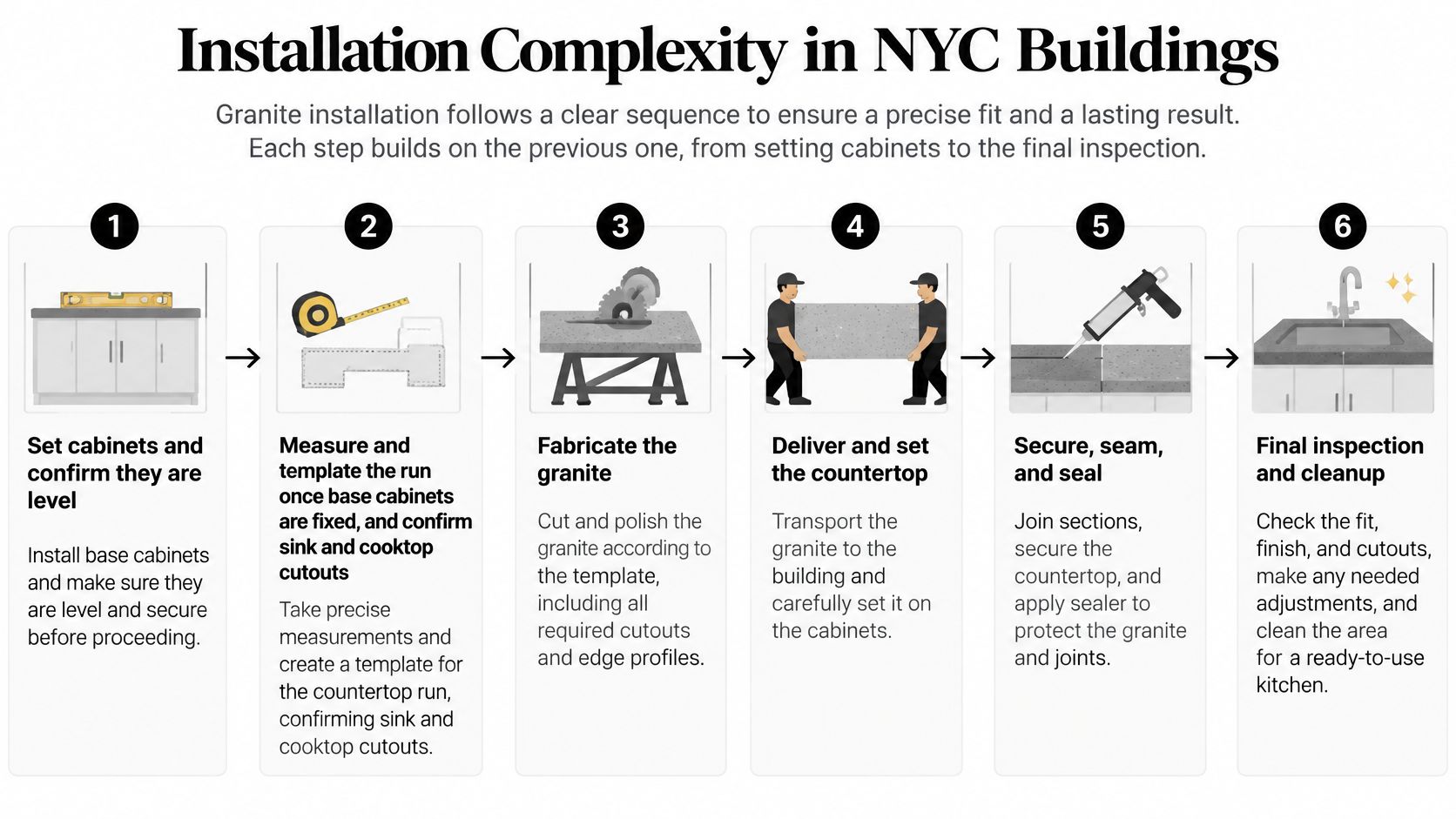
Granite installation is a sequence, and skipping ahead in that sequence is where delays come from. Laminate follows the same order with fewer shop steps, lighter pieces, and a shorter lead time.
The Granite Install Sequence
- Set cabinets and confirm they are level: Stone won't forgive a cabinet run that's out of level, so base cabinets get fixed and checked first.
- Measure and template the run: Once base cabinets are fixed, the fabricator templates the run and confirms sink and cooktop cutouts against the actual appliances.
- Approve the slab and layout: You select the slab and approve where seams and veining fall, then the shop fabricates, which lengthens the schedule compared with laminate.
- Schedule delivery and access: Heavy slabs may need elevator reservations, freight access, or stair carries, all booked within your building's work window.
- Set, seam, and seal: The crew sets the top, places seams around the sink and cooktop, seals the stone, and then the sink gets connected.
Both materials need rough plumbing and electrical in place before templating, so countertop timing depends on the rest of the kitchen. Plan installation after cabinets are set and before final plumbing connections. If your rough work slips a week, your template date slips with it, and the fabrication queue may not hold your slot.
Building Rules That Shape the Job
Co-op and condo boards often require a certificate of insurance and a scheduled work window before anyone brings material through the lobby. Your alteration agreement should state the delivery method and the weight of the material before the slab is ordered, not after it's on a truck. This NYC co-op renovation approval guide walks through the paperwork owners typically face.
Laminate eases several of these constraints. Pieces are lighter, can be trimmed on site, and fit a walk-up or tight apartment without special handling. If your building access is difficult and your timeline is short, that's a legitimate reason to choose it, separate from price.
Appearance and Resale Value Compared
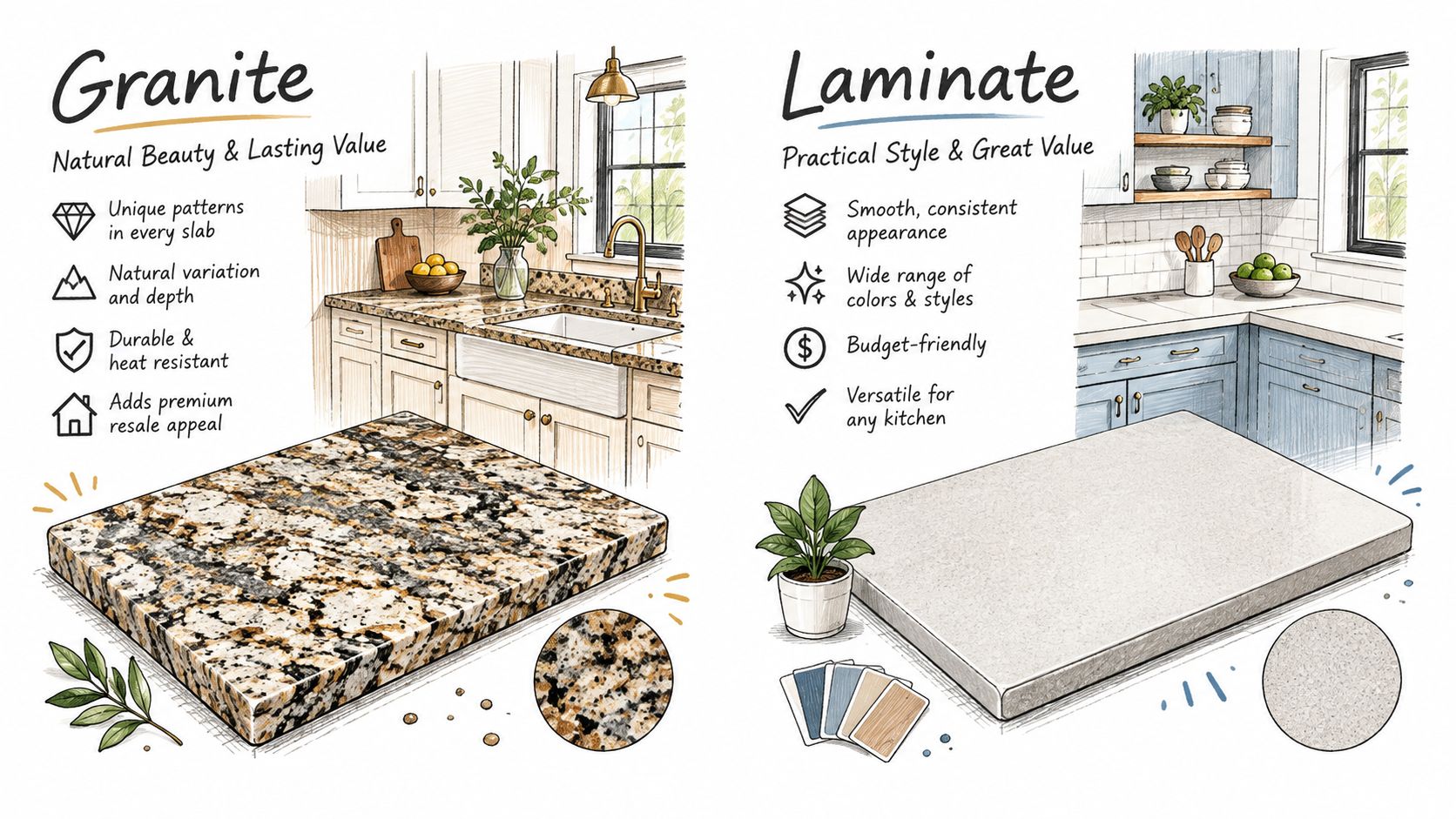
Granite gives you natural variation and depth that no printed pattern fully reproduces. Each slab differs from the next, which is the appeal and also the risk. You should approve the actual slab, because the sample in a showroom may be calmer or busier than what arrives.
Laminate gives you consistency. Wood-look and stone-look designs have become more convincing, and a full run matches from end to end without slab hunting. Close inspection still reveals repeating patterns, and in good window light the surface reads flatter than stone because the image sits on top rather than running through the material.
Seams and Edges in Real Light
Granite seams can be planned around the sink and cooktop, where breaks in the run already exist, and a good fabricator color-matches the joint. Laminate seams and edge banding tend to show more, especially where two pieces meet at a corner and the pattern can't wrap. Mitered laminate edges look cleaner than a visible banded strip, so ask which edge treatment a quote includes.
Buyers judge a kitchen in the first few seconds of a listing photo, then confirm or reverse that judgement in person. Laminate that photographs well can still disappoint at arm's length if seams and edges weren't detailed carefully.
What Resale Actually Rewards
A granite counter is widely seen as a premium, durable upgrade that buyers expect at mid-to-high price points. Laminate in an otherwise well-finished kitchen rarely hurts value, but it rarely adds much either. Neither material rescues a kitchen on its own. Appraisals and buyers weigh cabinetry condition, appliances, lighting, layout, and overall finish quality, and those usually matter more than the countertop alone.
For a rental or short hold, match the surface to the rent level. Overspending on stone that tenants will treat hard doesn't return its cost. For an owner-occupied home or a listing in a competitive Brooklyn or Manhattan market, match the material to recent comparable sales in your neighborhood. If comparable kitchens show stone, laminate can make your renovation read as unfinished. If they don't, granite is a quality-of-life purchase, and you should buy it for that reason rather than an expected payback.
Which Countertop to Choose for Your NYC Kitchen
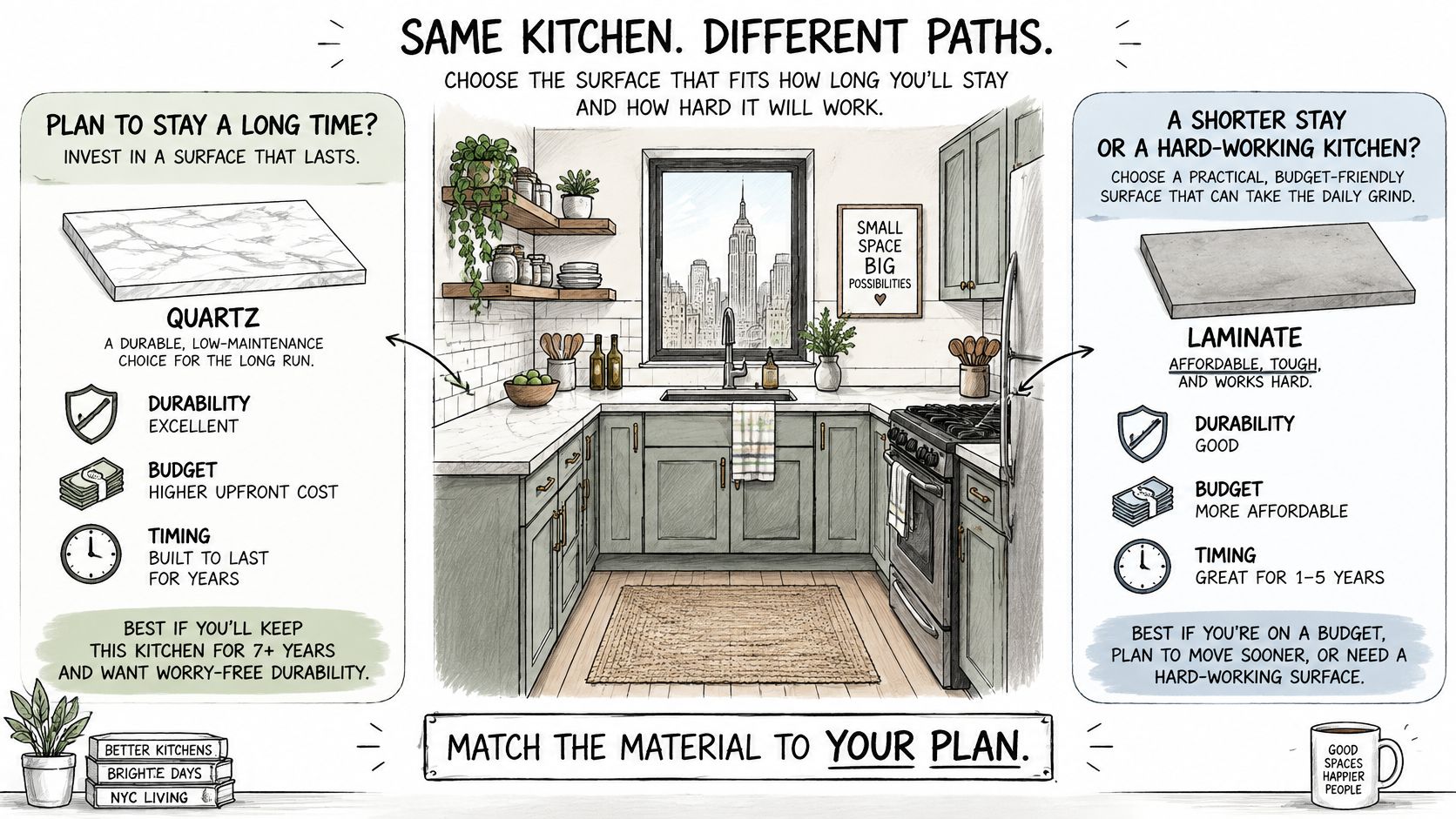
Choose the material that matches how long the layout will stay and how hard the surface will work. Everything else, including color, is secondary to those two facts.
| Situation | Better fit | Main reason |
|---|---|---|
| Rental unit or ownership under 5 years | Laminate | Lowest installed cost and acceptable replacement risk |
| Layout likely to change within a decade | Laminate | Avoids a costly granite removal and reinstall |
| Heavy knife work, hot cookware or a large household | Granite | Excellent abrasion and heat resistance |
| Long-term owner-occupied home with a stable layout | Granite | Lower cost per year over a 50-year life |
| Tight budget with cabinetry or plumbing competing for funds | Laminate | Frees money for structural or system work |
| Co-op or condo with strict access rules | Granite if staying long term | Replacement means repeat board approvals and disruption |
Three Situations Worked Through
Say you're refreshing a rental that will turn over in three years. Laminate is the rational specification. You'll recover the low installed cost in rent, tenants won't follow a sealing schedule, and if a section gets scorched you can replace it during a normal turnover without a fabrication lead time.
Say a family cooks daily, with cast iron moving on and off burners and several people prepping in one zone. Granite earns its price there. You'll use its heat and abrasion resistance every week, and the surface won't need replacement during the years the household is hardest on it. The commitment you're accepting is the water bead test and resealing when it fails.
Say you own a co-op and any future replacement needs board approval, insurance paperwork, and a reserved elevator. Repeating that process in twelve years has a real cost in time and disruption, on top of the second countertop. If the layout is stable and you're staying, granite's long service life lets you do the paperwork once. If you expect to gut the kitchen within a decade, laminate avoids demolishing expensive stone you barely used.
Mixed Specifications and the Estimate to Request
A mixed approach can work well. Laminate perimeter counters with a granite island put stone where heat, knife work, and visual attention concentrate, and keep cost down on runs that mostly hold small appliances. The reverse split makes less sense, because the sink run is where laminate needs the most moisture protection. If laminate goes at the sink, specify careful sealing at the cutout and seams, and plan to inspect them.
Ask any contractor for a written side-by-side estimate that prices both options line by line for your exact kitchen. Templating, slab, fabrication, delivery, access, removal, and plumbing reconnection should appear as separate lines, so you can see what's driving the difference. A general contractor such as Excellent Home Improvement, which handles kitchen remodeling including countertop sourcing, templating, fabrication, and installation coordination, is one option for getting both specifications priced on the same scope. Whoever you hire, don't compare a granite all-in quote against a laminate material-only number.
Before you commit, answer three questions in writing. How many years will this layout stay? How is the kitchen used on an ordinary weeknight, not on holidays? How much budget remains after cabinetry, plumbing, and electrical are priced? If the layout stays, the cooking is heavy, and the budget holds, I would choose granite and budget the sealing. If any one of those answers points the other way, laminate isn't a compromise. It's the correct specification for that project.
If you're weighing granite against laminate for a Bronx, Westchester, or five-borough kitchen, Excellent Home Improvement can price both materials on the same written scope, including templating, fabrication, building access, and installation, so you can compare cost per year rather than sticker price. Visit Excellent Home Improvement to request a side-by-side estimate and talk through which surface fits your timeline and your building.