Quartz vs Granite Countertops: Which Should You Choose?
Quartz vs granite countertops compared on cost, upkeep, heat, silica safety and repairs, with a clear verdict for NYC kitchen renovations.
By Excellent Home Improvement & Remodeling
The usual advice, choose quartz for convenience and granite for beauty, leaves out decisions that can matter more than either. A countertop must survive your cooking habits, arrive through a workable installation process, and remain repairable when something goes wrong. Low maintenance isn't the same as low lifetime risk.
A useful comparison of quartz vs granite countertops therefore goes beyond stain resistance. For a Bronx kitchen, an occupied co-op, or a rental rehabilitation, the better purchase depends on who maintains the surface, how the fabricator controls dust, and what happens after damage.
Table of Contents
- Quartz vs Granite at a Glance
- What Each Surface Costs Installed
- Daily Upkeep, Sealing and Heat Tolerance
- Silica Exposure During Fabrication and Installation
- Repairs, Resale and Long-Term Ownership
- Which Stone Fits Your Kitchen
- Confirm the Slab and Quote Before You Order
Quartz vs Granite at a Glance
Quartz suits busy kitchens that want uniform color and low upkeep; granite suits buyers who want natural veining and the possibility of localized stone repairs. Neither advantage makes one material the automatic winner.
Quartz and granite compared on core properties
| Factor | Engineered Quartz | Natural Granite |
|---|---|---|
| Origin | Mineral aggregate, polymer resin and pigments | Natural igneous rock cut as slabs from quarries |
| Crystalline silica | High-silica formulations are common; request product-specific composition | Contains crystalline silica; request slab-specific composition |
| Sealing | Not needed for stain protection | Periodic sealing recommended according to the stone's absorption |
| Heat tolerance | Hot cookware can damage resin; use trivets | Better direct-heat tolerance; thermal shock can still cause cracking |
| Pattern | Repeatable colors and patterns across slabs | Unique veining and mineral variation from slab to slab |
| Market position | Growing popularity among surveyed kitchen professionals | Established natural-stone choice with a substantial market share |
The manufacturing distinction explains much of the design difference: quartz is manufactured, while granite is selected from naturally formed slabs. Grand View Research estimates that granite accounted for approximately 27.9% of U.S. countertop revenue in 2025, evidence that it remains an established choice rather than an obsolete one.
Popularity expectations tell a different story. In the 2024 National Kitchen & Bath Association kitchen trends report, 73% of surveyed industry professionals expected quartz to increase in popularity over the following three years, compared with 32% for granite, as reported by Real Simple. Those are professional expectations, not measured homeowner satisfaction or proof of better performance.
Read the comparison as a starting point
A manufactured pattern gives the designer greater control, but it doesn't eliminate the need to approve slab layout and seams. Natural variation gives granite its appeal, but a small sample can't represent the whole island.
Our countertop selection includes engineered quartz and natural marble, granite and quartzite. Quartz and quartzite aren't interchangeable names, so keep the exact material designation on the selection sheet and proposal.
The table describes typical behavior, not a warranty for every slab. Product composition, finish, stone absorption and fabrication details all affect the result. The fabricator's written product information should take priority over a generic material comparison.
What Each Surface Costs Installed
Installed countertop cost by material
| Material | Cost for a 25 sq ft counter |
|---|---|
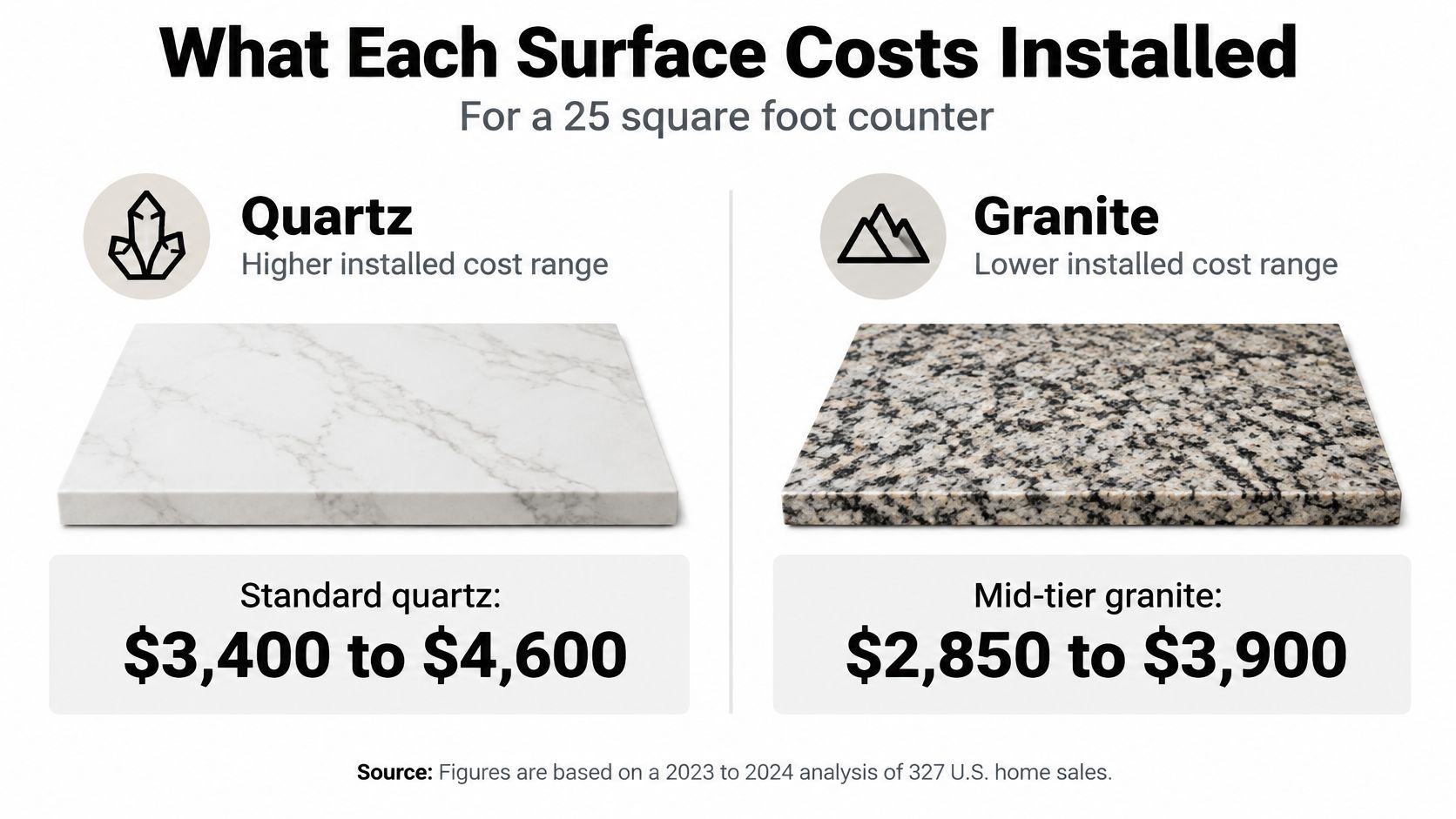
| Engineered quartz | $3,400 to $4,600 for standard quartz |
| Granite | $2,850 to $3,900 for mid-tier granite |
In a 2023–2024 analysis of 327 home sales across nine U.S. states, Construction Flux reported the installed ranges above; dividing those totals by the stated area produces approximately $136 to $184 per square foot for quartz and $114 to $156 for granite. These are published benchmarks, not quotes for a particular New York apartment.
Our engineered quartz countertops cost $70 to $120 per square foot installed. That business-specific range and the published analysis shouldn't be blended into a single average: they describe different offerings and project populations, without establishing identical scope.
Why published prices disagree
A square-foot price becomes useful only after you know what it includes. Slab selection, fabrication complexity and site work can change the total independently of the surface area.
Compare these scope items explicitly:
- Slab tier and selection: Identify the actual product or selected stone, not just the word quartz or granite.
- Edges and cutouts: Specify the edge profile, sink opening, faucet holes and any cooktop cutout.
- Backsplash and seams: Record backsplash coverage, seam locations and treatment of exposed ends.
- Removal and reconnection: Separate old-counter disposal, plumbing disconnection and reconnection from fabrication.
- Access and protection: Establish responsibility for building protection, delivery coordination and carrying the slabs into place.
Say one quote includes a backsplash and removal, while another covers only the new horizontal surface. The lower total doesn't establish a cheaper material. It establishes a narrower proposal.
Compare the whole kitchen, not an isolated surface
Request paired, line-item proposals using comparable product tiers and the same drawing. Keep the edge, openings and proposed seams consistent, then ask the estimator to identify any material-specific changes.
Budget rule: Compare the finished scope you're buying, not the smallest square-foot number on the page.
Countertops also interact with cabinetry, appliances and plumbing. A surface selected before the sink and cabinet layout are settled can require redesign rather than choosing a different slab.
Our kitchen remodeling starts from $20K, with permits included. Use our Bronx kitchen remodel cost guide to place the countertop allowance within the renovation budget, rather than spending against a surface estimate before the rest of the work is defined.
Daily Upkeep, Sealing and Heat Tolerance
In comparative laboratory evaluations, Consumer Reports found that quartz resisted stains from common foods and household substances, cutting, abrasion and hot-pot exposure; it also notes that quartz doesn't require sealing for stain protection. That supports quartz's low-maintenance reputation, but it doesn't make the surface immune to misuse.
The resin-containing matrix reduces liquid penetration and gives quartz a consistent, nonporous working surface. For the owner, that removes a recurring sealing task. It doesn't remove the need to clean spills or protect the countertop from damaging heat.
Build care around the failure you want to prevent
For everyday cleaning, use mild soap, water and a soft cloth, then remove cleaner residue. Avoid abrasive pads and harsh solvents, which can damage the finish or create a visible difference between the cleaned area and surrounding surface.
For granite sealing, establish the stone's absorption rather than assuming every slab needs the same calendar. Place water on a clean, dry area and check whether the stone darkens as it absorbs moisture; if it does, discuss resealing with the stone specialist.
A water check is a screening method, not a complete diagnosis of a finish problem. Existing coatings, surface residue and the particular stone can affect what you see. Use a compatible penetrating stone sealer when resealing is appropriate, and remove excess product rather than letting it dry as a film.
Keep heat and impact separate
Quartz's performance in a hot-pot test shouldn't become permission to park cookware directly on it. Use trivets, provide suitable clearance around cooking appliances, and identify a landing area for pans before installation.
Granite offers stronger direct-heat tolerance, but sudden temperature changes can still cause cracking. A trivet remains a sensible precaution on either surface, especially near seams, edges and cutouts.
- Prevent impact damage: Don't strike exposed corners with heavy cookware or use an unsupported edge as a workbench.
- Protect the finish: Use a cutting board rather than treating scratch resistance as permission to cut directly on the counter.
- Handle chips professionally: Have a stone repair specialist assess damaged edges instead of sanding or filling them experimentally.
Quartz reduces routine maintenance; it doesn't eliminate rules for heat, cleaning or impact.
For a Bronx kitchen or rental rehab, that distinction matters. Quartz can reduce dependence on the next occupant remembering to reseal, but the handover should still include cleaning instructions, heat protection and clear guidance on reporting chips.
Silica Exposure During Fabrication and Installation
Choosing granite doesn't automatically solve the worker-safety problem. Cutting, grinding and polishing either material can release respirable crystalline silica dust, so the fabrication method belongs in the purchasing decision.
The occupational silica document hosted by CDC describes engineered quartz as commonly containing more than 90% crystalline silica, compared with around 30% for granite. These are typical compositions, not a substitute for the selected product's written composition information.
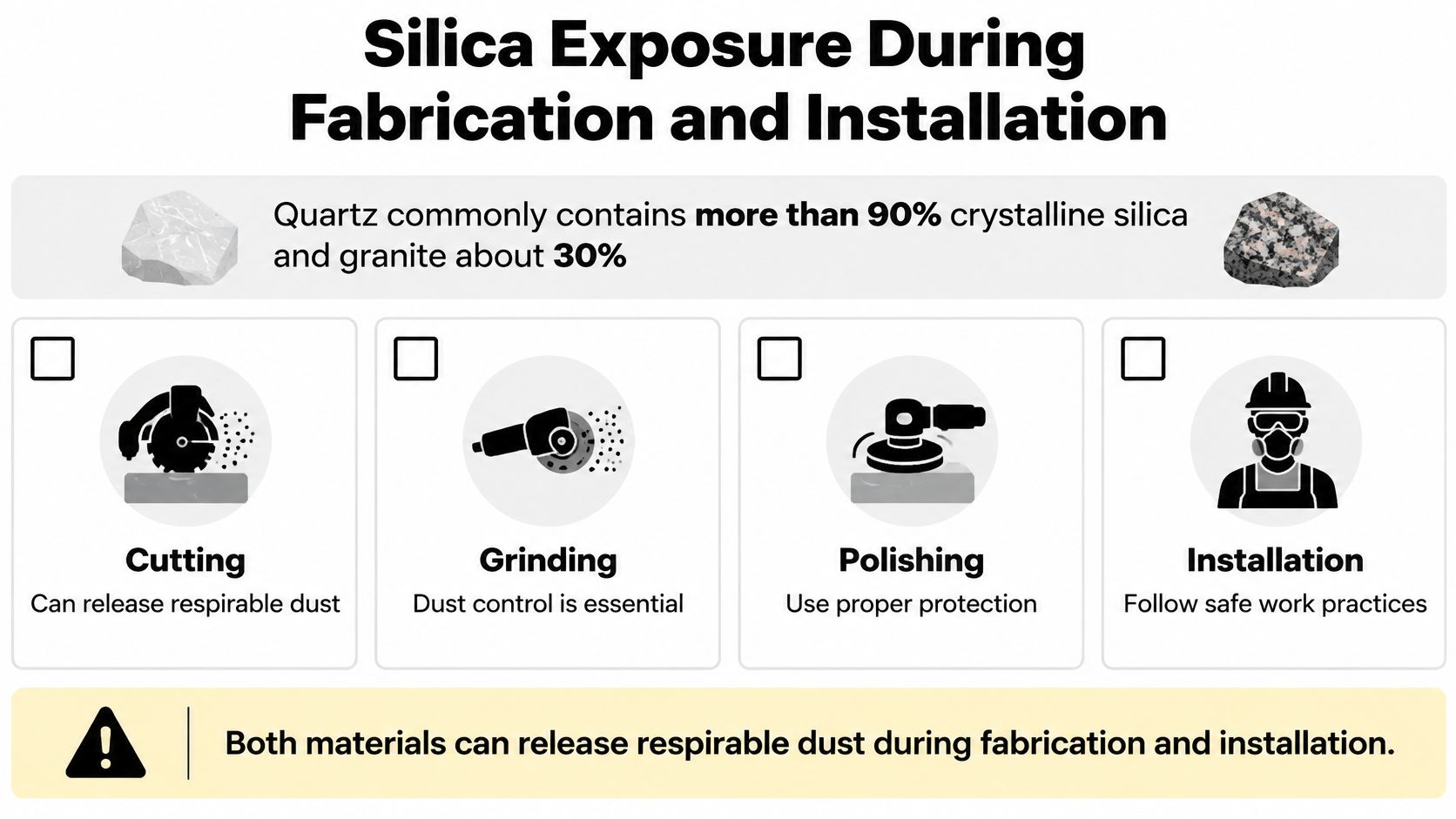
The principal concern is dust generated while workers process the material, not ordinary use of an intact, installed countertop. That distinction prevents two mistakes: treating a finished quartz counter as an everyday dust source, and treating a brief on-site adjustment as harmless.
Request a written fabrication and installation plan
The homeowner shouldn't have to design an occupational safety program. The homeowner can, however, require the fabricator to explain how it will control exposure and protect an occupied property.
Ask for the following before authorizing work:
- Wet methods at each tool: Confirm how saws and grinders receive water and how slurry is collected.
- No dry sweeping: Require cleanup methods that don't put settled dust back into the air.
- Local exhaust and containment: Identify extraction equipment and how the work zone will be isolated.
- Appropriate respiratory protection: Ask how workers are provided with suitable, fit-tested respirators where required.
- Worker medical safeguards: Confirm that the employer provides applicable exposure monitoring and medical surveillance.
- Written slab composition: Obtain product-specific crystalline silica information rather than relying on the material name.
- HEPA cleanup: Establish how surfaces, tools and the occupied area will be cleaned before containment is removed.
- Protection beyond the apartment: Include shared hallways, delivery routes and neighboring units in the plan.
Treat on-site changes as planned work
A sink opening that needs adjustment can create the same category of dust concern as shop fabrication. Ask where alterations will happen and who can authorize them. Don't accept an improvised dry cut in an occupied kitchen because the main slab has already arrived.
For a co-op or condo, the dust plan should agree with the alteration package and building access arrangements. Residents need to know which areas will be unavailable and how workers will prevent dust from reaching common spaces.
The correct conclusion isn't that both materials present identical risk. High-silica engineered stone creates a particularly serious exposure concern. The conclusion is that composition and controls must be evaluated together: granite also requires protection, and a material label alone can't establish that a job is safe.
Repairs, Resale and Long-Term Ownership
Showroom comparisons usually end at stain resistance. Ownership begins where the comparison chart stops, at the first chip, the scorched patch and the listing photo years later.
Repair outcomes for common damage
| Damage | Quartz | Granite |
|---|---|---|
| Surface scratch | Specialist assessment; refinishing may alter the sheen or pattern | Some scratches can be polished by a stone specialist |
| Chipped edge | Professional filling; the repair may remain visible | Professional filling and polishing can blend localized damage |
| Heat damage | Discolored resin may require replacement of the affected piece | Assess for cracking and repair feasibility |
| Set-in stain | Use a product-compatible treatment; removal isn't guaranteed | A specialist may use a poultice, then address sealing |
| Large damage | Replacement may be necessary; matching material may be unavailable | Localized repair may be possible; extensive damage can require replacement |
Quartz is generally easier to maintain; granite can be more serviceable after localized damage. Those are different ownership advantages, and they pay out at different moments.
Quartz's manufactured pigments and resin make an invisible repair difficult to promise. Some granite damage can be filled, polished or resealed by a specialist, potentially preserving the existing slab. Composition matters a second time here. Grinding out a chip, polishing a scratch or cutting a replacement piece produces dust, so the written questions about silica content and work methods belong in every future service call, not only in the original installation plan.
Ask what happens after an accident
Consider a chipped sink edge. A satisfactory outcome might be a structurally sound fill that remains slightly visible. Showroom condition is a separate, higher standard that repairs rarely reach, so establish what the contractor means by repair before deciding that repairability settles the comparison.
Ask these questions:
- Future matching: Is material from the same slab lot still available, and what would a later replacement match realistically look like?
- Written coverage: Does the repair policy cover workmanship defects, accidental damage, assessment visits or only particular conditions?
- Replacement boundaries: Can an affected section be removed without replacing the adjoining run, backsplash or sink?
A spare offcut may help with some repairs, but it isn't a guarantee of a perfect replacement. Geometry, pattern direction and the size of the damaged area still matter. An offcut blends best on a plain color; a heavily veined slab may never hide the seam.
Separate resale appeal from resale return
Buyers respond to granite's recognizable natural-stone character and to quartz's controlled, repeatable appearance. Both reactions are matters of taste, and taste alone doesn't establish a predictable financial return for a particular Bronx apartment.
For resale planning, choose a surface that works with the cabinets, lighting and overall condition of the kitchen. Don't pay a premium solely because a material is described as more desirable without evidence relevant to the property.
Which lasts longer? There is no defensible universal winner here. Granite's performance changes with mineral composition, porosity, finish and upkeep. Quartz's engineered consistency answers some of those variables and introduces others, since heat can discolor resin and a filled chip can stay visible. The useful comparison is the likely damage, the acceptable repair outcome and the cost of replacement, not performance against spills alone.
Which Stone Fits Your Kitchen
A countertop earns its keep under the worst week in the kitchen: back-to-back cooking, a hot tray set down in a hurry, a splatter that sits until morning, a crowded service elevator for the install. Match the stone to the failure mode you are prepared to own.
Best fit by renovation situation
| Situation | Better Fit | Why |
|---|---|---|
| Heavy daily cooking with stain and spill control first | Quartz | Nonporous surface keeps stain control from depending on routine sealing |
| Design built around natural veining and one-of-a-kind slabs | Granite | Individual slab character |
| Frequent hot pans and no room for trivets | Granite | Better direct-heat tolerance, although protection is still advisable |
| Long run or multi-unit rehab needing matching color | Quartz | More controlled, repeatable appearance |
| Expected future local repairs without full replacement | Granite | Specialist polishing and localized repair may be possible |
| Co-op or condo with board approval and an occupied building | Either, with a written dust plan | Fabrication method and cleanup controls decide the exposure risk |
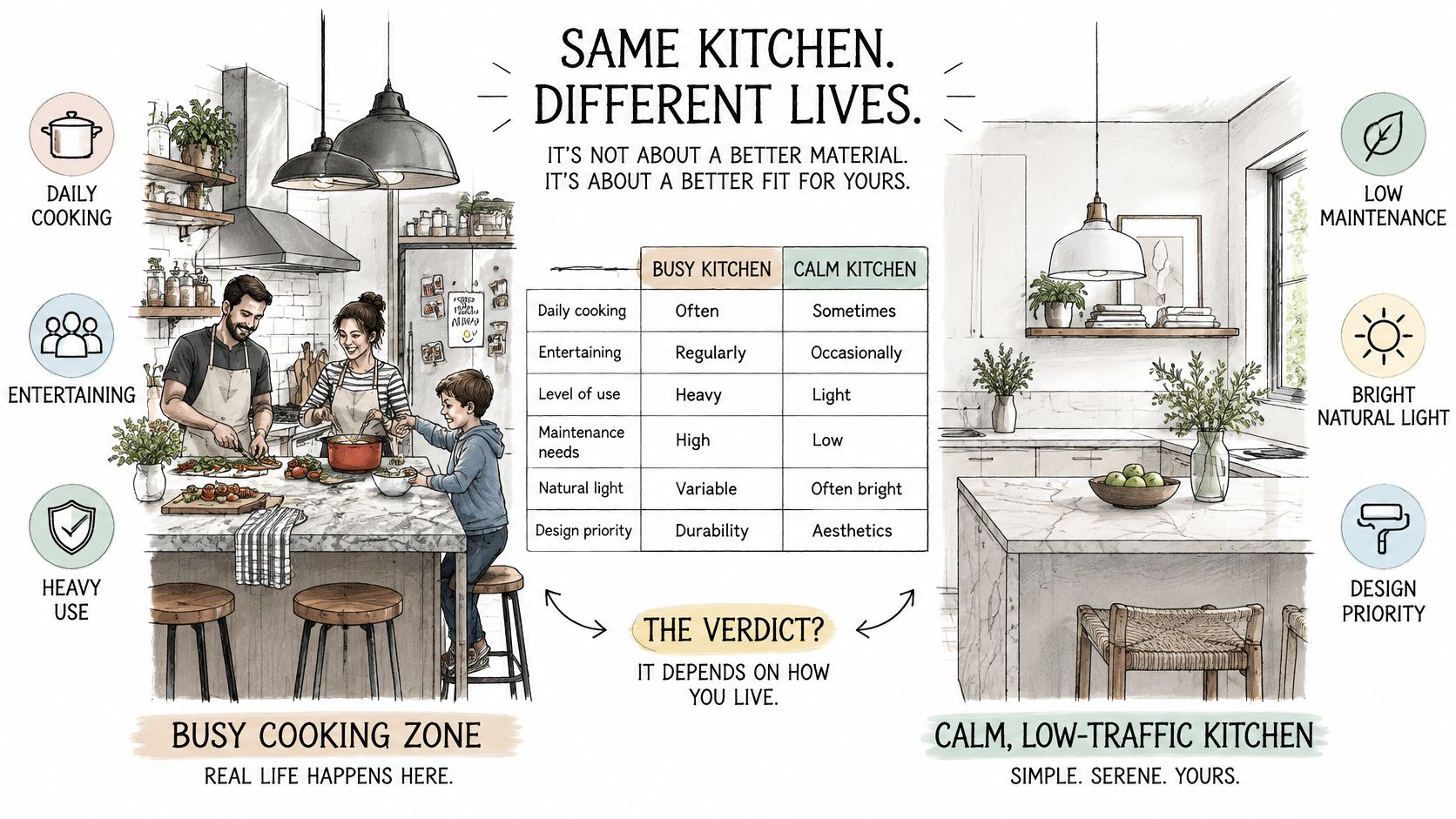
Resolve the choices most likely to cause regret
If pans constantly leave the stove, treat heat tolerance as a use requirement rather than a habit the household may learn. Granite gives that pattern more margin, and a defined landing area near the range still reduces how often the margin gets tested.
If neglected spills are the main concern, quartz keeps stain protection from riding on a sealing calendar. A feature island raises a different question: approve the actual granite slab when its movement is the reason for buying it. For repeated installations, controlled quartz color can simplify selection, and the production material plus seam layout still need approval because later batches can shift.
Buy for the damage you can repair, the dust plan you can enforce and the upkeep your household will actually do.
For apartment work, we handle co-op and condo board packages, building-hour compliance and protected common areas. Our kitchen remodeling service coordinates the countertop with cabinetry, appliance integration, lighting design and layouts built around how the household cooks. If appliances are panel-ready, they must be specified before cabinetry is ordered so confirmed clearances shape the counter run.
Confirm the Slab and Quote Before You Order
A material decision becomes an order only when the product, fabrication scope and installation arrangements are documented. Use this checklist before paying for a selection that can't easily be changed.
View the actual slabs and compare equivalent tiers. Inspect full-slab pattern and finish in person, then compare samples under your kitchen lighting, because a screen image can't establish how the surface will look in the room.
Pull forward the silica paperwork. The composition sheet and written dust plan called for during the silica assessment belong in this order file, ready to check against the fabricator's stated methods.
Match the quote drawings and scope. Keep edge profiles, openings, backsplash coverage and seam layout consistent so the price difference reflects the selected material rather than omitted work.
Get a written post-demolition schedule. Our kitchens typically finish in 6 to 10 weeks after demolition, so the schedule should show where countertop measuring, fabrication and installation sit alongside the other trades.
Complete final measuring after cabinets are set. Pre-war apartment walls are rarely square, so we require scribe panels on cabinetry installs and coordinate the countertop template with the installed cabinet positions.
Carry the repair answers into the contract. The written coverage and slab-availability check from the ownership comparison should arrive here as signed terms in the document you are about to approve.
Turn the selection into a coordinated order
Our countertop selection service covers engineered quartz and natural granite, marble and quartzite, and includes slab-viewing appointments. Bring the layout drawing to that appointment. Approving the actual slab is the moment to map where its pattern falls around the sink, corners and seams.
Two coordination points belong in the same conversation. If the design includes panel-ready appliances, specify them before cabinetry is ordered, since their dimensions shape the cabinet openings the template will follow. Where the countertop sits inside a larger renovation, our kitchen remodeling starts from $20K, with permits included.
Keep the approved slab identification, layout drawing, care instructions and proposal together. Those documents address separate risks: appearance, fit, cost, exposure during work and repair after damage.
Before ordering, make one final decision: which material's failure can you accept? Answer it standing in front of the slab you will receive, with the drawing that shows where every seam and cutout will land.
Excellent Home Improvement offers engineered quartz and natural marble, granite and quartzite countertops, slab-viewing appointments, and coordinated kitchen design, sourcing and construction. Visit Excellent Home Improvement to arrange your countertop selection and discuss a proposal that connects the slab, cabinetry and apartment renovation requirements.