Which Is Better for Countertops Granite or Quartz?
Which is better for countertops granite or quartz? Compare heat, scratch resistance, sealing, silica safety and NYC installed prices to choose the right stone.
By Excellent Home Improvement & Remodeling
Which is better for countertops granite or quartz? Most answers rank hardness, crown a winner, and stop there. That ranking settles a question nobody asks after installation day, because both stones shrug off a kitchen knife and neither one dies from a knife.
The failures that happen look nothing alike. A quartz top discolors under a pan lifted straight off the burner. A granite top blooms an oil stain because the sealer lapsed two winters back. One of those ends with a fabricator's truck outside your building. The other ends with a rag and forty minutes.
What follows separates the two stones by failure mode, composition, care calendar, fabrication risk and installed cost, then ties each verdict to the way New York apartments, brownstones and co-ops get used. Where the evidence doesn't settle a point, resale being the obvious one, I say so instead of inventing a number.
Table of Contents
- Granite vs Quartz at a Glance
- How Each Stone Is Made and Who Leads the Market
- Heat, Scratches and Stains Where Each Stone Wins
- Sealing and Maintenance Over a Countertop's Lifetime
- Silica Safety and Fabrication Quality Matter Too
- Which Stone Fits Your NYC Kitchen or Bathroom
- Price Your Options and Book a Slab Review
Granite vs Quartz at a Glance
Hardness is the wrong tie-breaker. Granite and quartz part ways on heat, pores, sunlight, and the dust a saw throws while the slab is cut.
Granite vs quartz performance at a glance
| Criterion | Granite | Quartz |
|---|---|---|
| Heat tolerance | Takes brief contact with a hot pan better; a very hot pan set on a cool section can still crack the slab | Polymer resin scorches or discolors under concentrated heat |
| Scratch resistance | Most minerals sit harder than common utensils | Quartz grains are hard, but abrasive pads dull the resin-rich surface |
| Water absorption | Higher, and it varies with mineral mix and finish | Very low |
| Routine sealing | Penetrating sealer at installation, then periodic resealing | None beyond routine cleaning |
| Direct sunlight | Handles high-sun and outdoor exposure | Standard indoor products may yellow or fade |
| Appearance | Unique mineral variation in every slab | Consistent color and pattern from slab to slab |
| Silica risk during fabrication | Cutting natural stone can still release silica dust | Engineered slabs can hold substantially more crystalline silica |
| Resale appeal | Condition, layout and care records drive it; no price premium attaches to the stone itself | The same rule applies; buyers read condition, not the label |
A south-facing co-op that takes hard afternoon light will fade a standard indoor quartz long before the same exposure bothers granite. A galley in a prewar walk-up often wants one color the full length of the wall, which is quartz's actual advantage, not its hardness. Cast-iron searing with no trivets marks the resin. Spills that sit, plus a lapsed sealer, mark granite's pores instead.
The fabrication row is the one most comparisons skip. Daily cooking does not raise the silica question. Cutting the slab does, and engineered material carries more crystalline silica than natural stone. In an occupied apartment, dust control during fabrication matters more than which surface wins a scratch test.
The short rule: quartz suits a kitchen that wants stain resistance, one color across a long run, and no maintenance calendar. Granite suits frequent high heat, hard afternoon light, and an owner who wants a slab nobody else has.
At a co-op open house, buyers notice etch, chips, and a neglected surface. They do not pay extra because the label says granite or quartz.
A per-square-foot rate without an edge profile and a sink cutout is not a budget. If the look has to come first, compare the countertop materials we install at a slab viewing before locking a color.
How Each Stone Is Made and Who Leads the Market
Granite varies from slab to slab because it forms naturally. A slab sold as Bianco Antico is a particular mix of feldspar, mica and quartz crystals, and that mix can shift across a quarry. Two kitchens ordered under the same granite name may therefore have visibly different counters. For a New York City kitchen with a long island or several connected counter runs, that variation needs to be assessed across the actual slabs, not inferred from a small sample.
The infographic compares how natural, engineered and lab-grown stone are produced and presents market-share information for those categories.
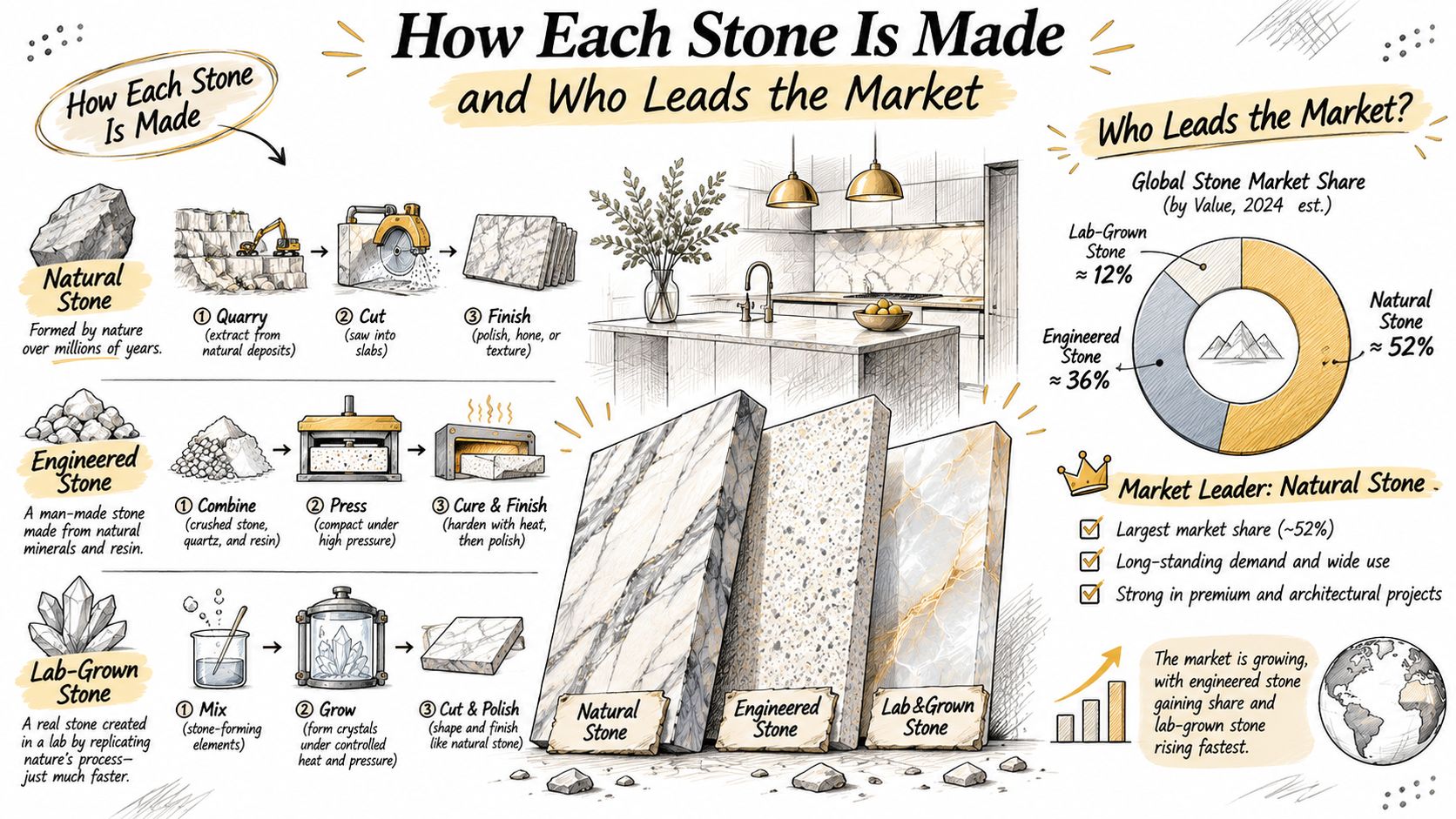
Engineered quartz is made by grinding quartz, combining it with polymer resin and pigment, then pressing and curing the mixture into slabs. That process produces a more uniform appearance: the color selected from a sample is designed to remain consistent across the slab and matching pieces. The trade-off is that the surface is manufactured rather than a one-of-a-kind pattern formed in a quarry.
What the market share proves and what it doesn't
Market adoption shows what buyers selected, not which material performs best in a particular kitchen. Engineered stone, primarily quartz composite, passed laminate in 2021 to become the most-used countertop material in the United States. The 2022 engineered-stone market report from ResearchAndMarkets also projected demand growth of roughly 9.6% annually, reaching 404 million square feet in 2026. These figures describe a growing market, not a performance advantage over granite.
For a compact NYC kitchen where matching counters across a short run matters, quartz's consistency may be useful. In a space where the natural pattern is part of the design, granite's slab-to-slab variation may be a reason to choose it, provided the selected slab suits the layout.
Carry this question forward: do you want natural variation that calls for viewing the slab, or a more uniform look that can be specified from a sample?
Heat, Scratches and Stains Where Each Stone Wins
Which countertop is more likely to fail in your kitchen? The answer depends on the stress: granite has the advantage with heat, while quartz is less vulnerable to staining. Scratches are a closer contest, and neither material is immune to chipped edges.
Where heat decides it
Granite is the safer choice for hot cookware, though it is not crack-proof. The Natural Stone Institute's granite reference reports that granite's minerals are harder than common kitchen utensils, supporting its strong scratch resistance. It also describes granite as typically tolerating temperatures up to approximately 250°C (480°F). A sudden temperature change can still stress a slab: placing a very hot pan on a cool area may cause thermal shock, so a trivet remains sensible.
Quartz contains hard mineral particles, but its resin binder is more vulnerable to direct heat. A hot pan can soften or discolor the resin, or contribute to a crack, even when the quartz particles remain intact. In an NYC kitchen where cooking happens in a tight work area, the practical risk is a pan set down briefly on the nearest clear spot. That makes consistent use of hot pads more important for quartz.
Scratch resistance is closer to a draw. The Natural Stone Institute's granite reference describes granite's mineral makeup, while its fact-versus-myth course explains that quartz is a hard mineral used in engineered surfaces. Neither should be treated as a cutting board. On quartz, abrasive pads and gritty cleansers can also wear the resin-rich surface, so use a gentler cleaning method.
Where stains decide it
Quartz generally resists liquid absorption better. The Natural Stone Institute's fact-versus-myth course puts water absorption at about 0.02 to 0.05% by weight for engineered quartz and roughly 0.10 to 0.40% for granite. Granite's absorption varies with its mineral composition and finish, so a lapse in sealing can leave it more exposed to staining. A wine spill on unsealed granite may become a lasting mark, while quartz is less likely to absorb it.
Quartz has its own failure scenario in a bright room. The same course cautions that standard indoor quartz products are not generally suited to prolonged direct sunlight, which may fade or yellow the resin system. That matters in a sunlit NYC kitchen or bathroom: a low-maintenance surface can still be the wrong choice if it receives strong, sustained sun.
Lab testing shows trade-offs rather than a universal winner. Consumer Reports' countertop testing found quartz resistant to spills, knives, abrasive pads and hot pots, while granite performed similarly against heat, cuts and scratches. Properly sealed polished and matte granite slabs also resisted most stains. Both materials can chip at corners and edges. A damaged edge may need a fabricator's repair, and a poor seam can undermine either slab regardless of its material.
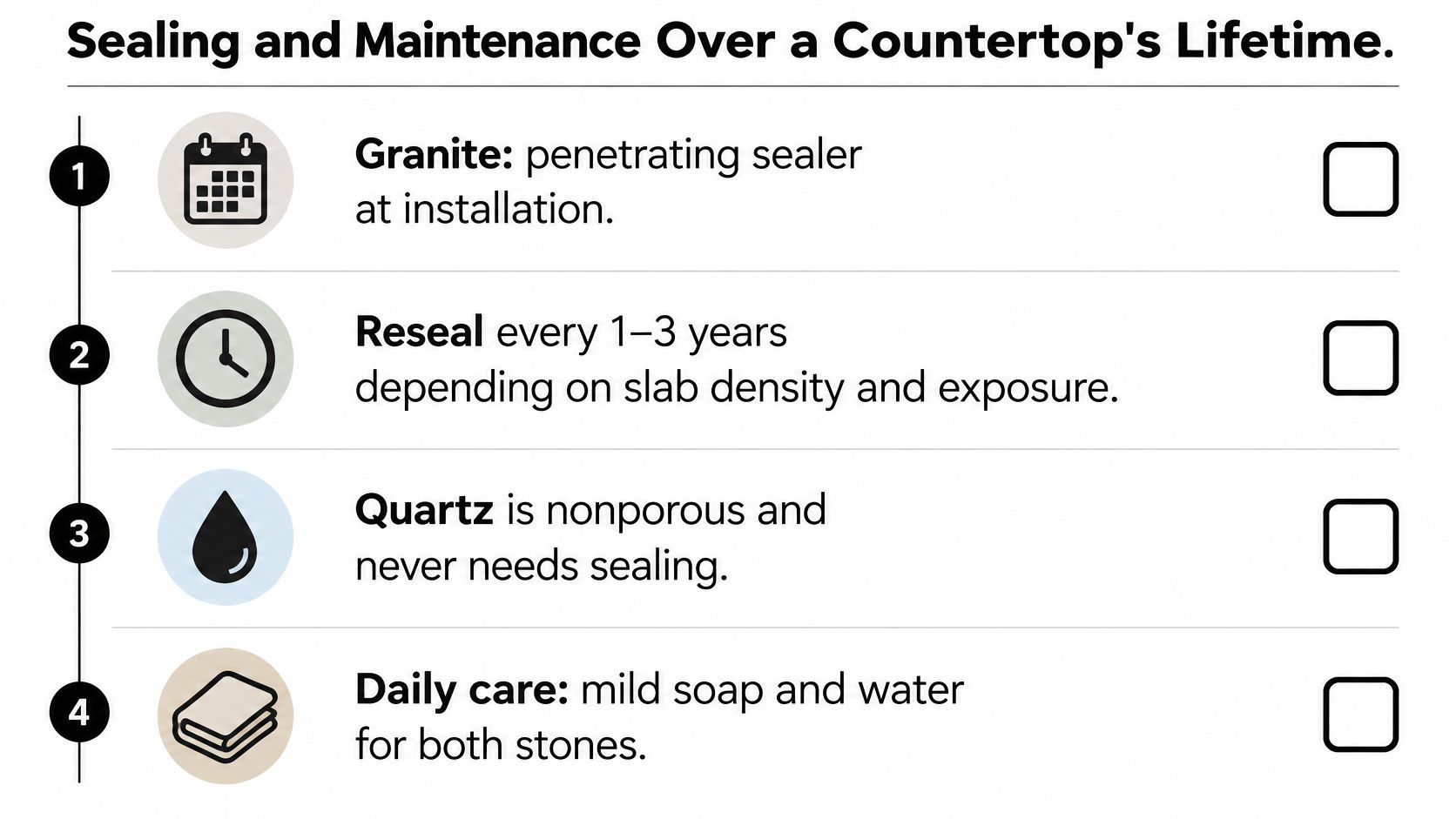
The maintenance infographic comparing sealing requirements and daily care tips for granite versus quartz countertops summarizes the care differences. In practice, granite is more forgiving around heat but depends more on its sealer to resist stains. Quartz reduces that sealing concern, but heat, prolonged sun and edge damage remain real vulnerabilities. At the slab review, inspect the corners and discuss seams with the fabricator, especially if the layout leaves exposed edges or long joins.
Sealing and Maintenance Over a Countertop's Lifetime
Which surface asks less of you after installation? Quartz generally needs only routine cleaning, while granite adds a recurring sealing task. That difference affects upkeep over the counter's lifetime, even when you handle the work yourself.
Engineered quartz is roughly 90% ground quartz bound with polymer resin and pigments. That resin can scorch or discolor at about 150°C (300°F), according to Stonify's comparison of the two stones. Granite typically needs a penetrating sealer at installation and periodic resealing, commonly every 1 to 3 years, depending on the slab's density and exposure. The schedule varies; the maintenance itself does not disappear.
The routine that keeps either stone honest
Daily wipe. Use a pH-neutral cleaner and a soft cloth on either surface. Avoid vinegar and citrus sprays on quartz. Repeated acid exposure can gradually dull the resin, which is why the familiar household habit of using vinegar spray every day can leave visible wear.
The water-bead test, monthly. Put a few drops of water on an inconspicuous area of granite. If they bead, the seal is holding. If the water darkens the stone within a couple of minutes, resealing is due.
Blot risky spills. Oils, wine, citrus and tomato can penetrate granite as its sealer weakens. Blot instead of wiping, so liquid does not spread across a larger area. Quartz is less vulnerable to absorption, but prompt cleanup still makes care simpler.
Inspect seams and exposed edges once a year. A chip in either material calls for professional repair. Home filler can remain visible under kitchen lighting, turning a small defect into a conspicuous mark.
Keep abrasives and harsh chemicals off quartz. They can soften or dull the surface without any hot pan involved. The result may be a flat, chalky patch in the sheen.
Decision test: If you will not track resealing over the life of the counter, quartz avoids that recurring task. If you will keep up with it, granite's maintenance schedule can be manageable, and its heat tolerance may suit a kitchen where hot cookware is often set down.
Care also depends on installation details, not just the stone. An eased edge is less exposed than a thin square edge, and an island overhang needs solid support. Ask the fabricator for written care guidance suited to the selected slab, then keep it with the home's records. That helps the next owner avoid treating granite and quartz as if they require identical upkeep.
Silica Safety and Fabrication Quality Matter Too
Silica questions usually arrive attached to the wrong object. The finished counter isn't the exposure. The saw is.
Respirable crystalline silica is a fabrication and installation hazard, not a residential-use one. Reporting on the countertop lung disease cases and the regulatory response tracks how quickly the rules moved: Australia prohibited the manufacture, supply and installation of engineered stone containing high levels of crystalline silica in 2024, and California tightened controls through 2025 while pursuing further restrictions into 2026. Evidence summarized by the American Thoracic Society in that reporting holds that artificial stone can contain substantially higher crystalline-silica concentrations than traditional natural stones such as granite and marble.
None of that makes a sealed quartz top hazardous to the people eating breakfast at it. It does change who should cut the slab and how the cutting happens, which is a procurement question most comparisons skip entirely.
Six questions to put to any fabricator
- Is every cut wet? Wet cutting suppresses dust at the blade. A dry cut in a closed garage is the scenario the regulations exist for.
- What local exhaust ventilation runs on site? Wet methods plus extraction is the working standard, not either one alone.
- Do crews wear respiratory protection? Ask what class of respirator and whether it's fit-tested, not whether they "have masks."
- How is dust cleaned up? HEPA vacuuming and wet wiping, never a broom and a box fan pushing fines into the next room.
- Is the slab's silica content documented? Manufacturers publish composition data, and lower-silica lines exist. Ask for the sheet.
- Are non-silica alternatives on the table? Sintered and porcelain surfaces sidestep the question if the answer matters to your household.
Tie-breaker: when two slabs are otherwise close in look and price, the fabricator's dust controls and the product's composition should decide between them.
This matters most in an occupied renovation. In a Manhattan or Bronx apartment, dust leaves on shoes and rides air currents into shared corridors, so containment is a building issue as much as an apartment one. Granite isn't exempt either. Cutting natural stone generates silica dust too. But the engineered category has drawn the heavier regulatory scrutiny, which makes composition and fabrication practice fair questions to put in writing rather than signs of a difficult customer.
Which Stone Fits Your NYC Kitchen or Bathroom
The material argument only becomes a decision when it meets a specific room.
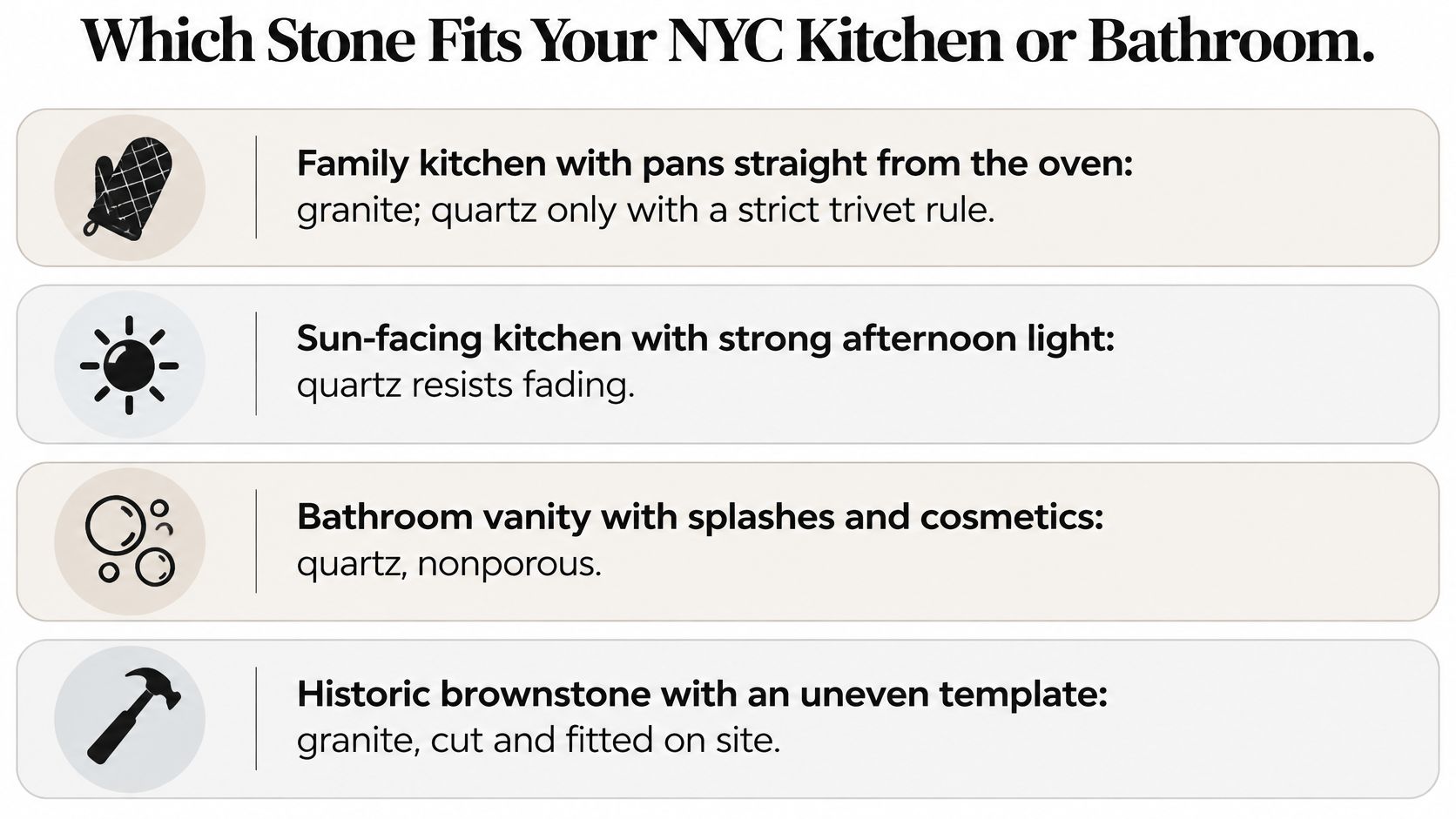
A family kitchen where pans leave the oven and land on the counter. Granite, unless the household sticks with trivets. Cast iron, roasting trays and a slow cooker running all afternoon are the daily pattern that scorches resin, and a scorch on quartz is a fabricator's job, not a Saturday project.
A kitchen with hard afternoon sun, or a counter that extends outside. Granite again, for the same structural reason. Standard indoor quartz isn't built for sustained direct sun, and a terrace counter takes far more of it than an indoor window seat ever will.
A rental or investor unit with turnover every few years. Quartz. Nobody has to remember a reseal between tenants, and a hot-pad rule printed in the unit guide costs nothing to write and prevents the expensive repair. Matching one replacement counter to the rest of the building is easier with a manufactured color as well.
A bathroom vanity in a pre-1978 building. Quartz for the splashes and cosmetics, but the stone isn't the risk in that room. We're an EPA Lead-Safe Certified Firm, and dust containment for pre-1978 work is standard on our jobs rather than an upgrade. Any contractor you hire for a pre-war bathroom should describe that containment before the first cabinet comes out.
A household that wants a slab nobody else has. Granite, with a viewing before the deposit. Photographs of a granite color show you the average of a quarry, not the slab sitting in the warehouse with your name on the hold.
Co-op and condo paperwork
Boards care about how the work happens, not which stone you pick. Alteration agreements, insurance certificates, work hours and elevator protection all get reviewed, and a mid-project question about the counter specification can hold up a demolition date. Keep the stone spec, the fabricator's dust-control answers and the care sheet in the same folder as the cabinetry order. We run alteration agreements and landmark requirements through one project manager for exactly that reason.
The chart below compresses the same verdicts into four common scenarios.
For a mixed household, let one essential criterion break the tie. If nothing is essential, choose quartz for convenience or granite for heat and sun. Then plan the kitchen remodeling sequence around slab lead time instead of the other way around.
Price Your Options and Book a Slab Review
Price two stones, not six. Every extra material in the comparison adds a slab yard trip and a quote you won't read carefully.
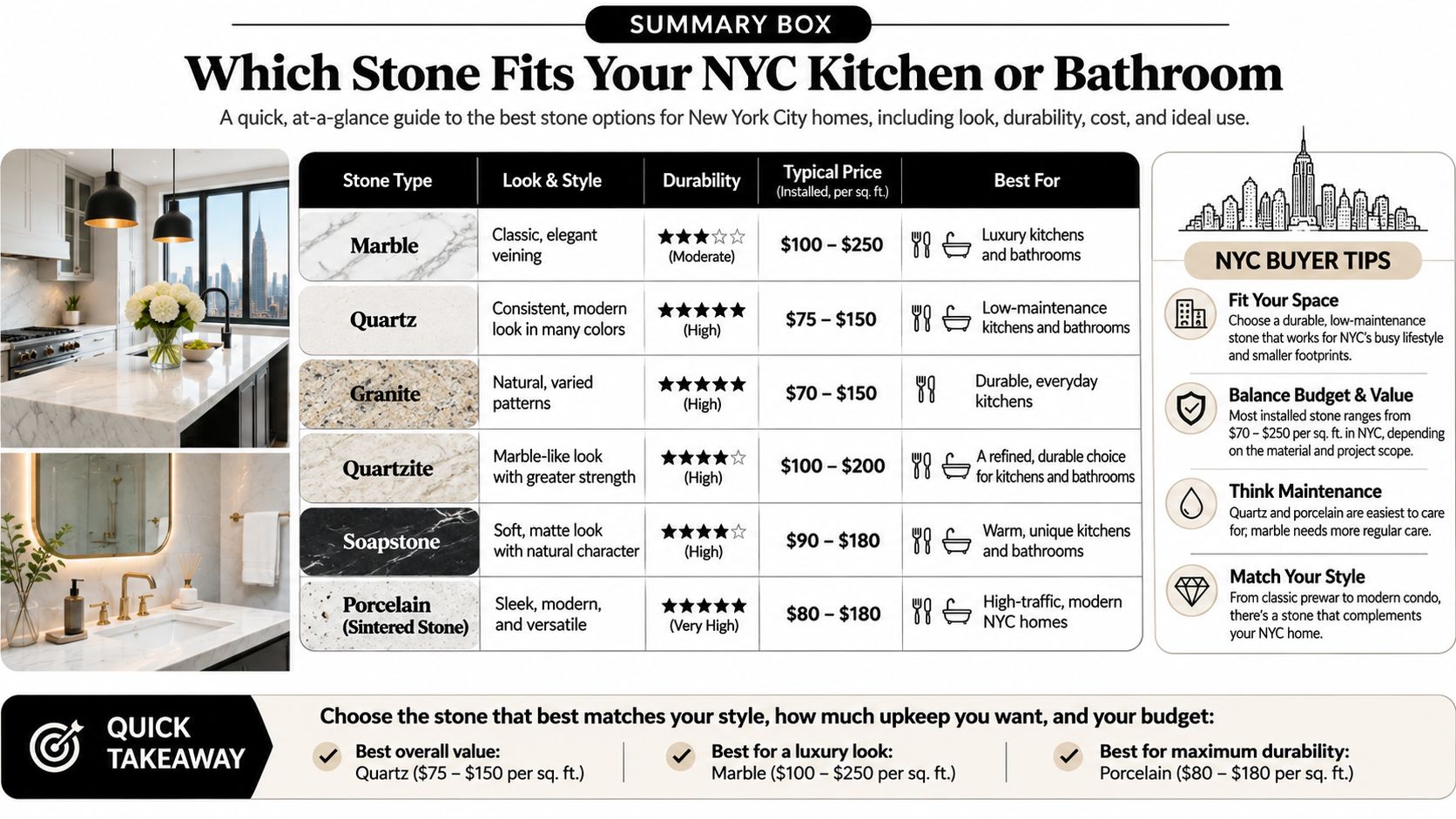
Start with the stone you're choosing. Engineered quartz runs about $70 to $120 per square foot installed. Granite has no honest single rate to publish, because the installed number moves with slab grade, thickness, edge profile and the fabricator's cutting fee. Leave that cell open until the written quote arrives. Substituting quartzite's or marble's rate as a stand-in for granite produces a budget nobody can hold you to.
Sample installed countertop prices
| Material | Installed price per sq ft | Best fit |
|---|---|---|
| Engineered quartz | $70 to $120 | Busy kitchens that want low upkeep and consistent color |
| Granite | Set by slab grade, thickness, edge profile and fabrication, so the figure arrives in the written quote | Heavy cooking, strong sun, and natural variation confirmed at slab viewing |
Turn a rate into one counter. Measure each run's length and depth in feet, multiply for square feet, then add the edge profile, backsplash and sink cutouts. A ten-foot run at 25.5 inches deep is about 21 square feet before waste, and you should allow 10 to 15% for cutouts and offcuts. Ask for the quote itemized that way, so you can see whether the gap between the two stones comes from the slab or from the labor.
Don't use resale as the tie-breaker. No verified premium shows granite beating quartz on resale value, or the reverse, which is why those cells stayed without numbers earlier. Buyers notice condition: a chip-free edge, consistent seams, a stain-free surface, and whether the seller can produce a care history. A quartz top with a scorch ring reads worse than a well-kept granite one, and the reverse holds equally true.
What the quote should contain: slab name and bundle, square footage with waste, edge profile, backsplash height, cutouts, tear-out, and the care instructions. If a line is missing, it isn't free.
Finish in this order. Lock the two criteria that matter most, view the slab under your own lighting, put the silica and dust-control questions to the fabricator, then get the written quote and care guide before cabinetry is ordered. Slab viewing appointments come included with our countertops, and the quote is fixed-price after a site walkthrough, so the number you approve is the number you pay. Our kitchen remodel cost guide for the Bronx breaks the ranges down by scope if you want a benchmark before that visit. Cabinet lead times run longer than expected, and ordering boxes before the stone is settled is how a kitchen ends up with a filler strip nobody planned for.
Excellent Home Improvement is a New York City general contractor that fabricates and installs both engineered quartz and natural granite, with slab-viewing appointments included so you can compare bundles under your own light before committing. We coordinate stone, cabinetry and plumbing in one fixed-price proposal after a site walkthrough, which keeps the counter decision from stalling the rest of the kitchen. Visit Excellent Home Improvement to book a slab review and bring the two criteria you won't compromise on.